 listicle
Tallow Balm for Dry Skin: Complete Guide
Table of Contents
- What Is Tallow Balm and Why It Works for Dry Skin
- Benefits of Grass-Fed Tallow for Skin
- Key Ingredients: What Makes Tallow Effective
- How to Use Tallow Balm in Your Skincare Routine
- Tallow Balm Shelf Life and Storage Conditions
- DIY Tallow Balm Recipe for Dry Skin
- Grass-Fed vs. Conventional Tallow: What Matters
- Is Tallow Safe for the Face and Sensitive Skin
- Frequently Asked Questions
Last Updated: September 2, 2026
What Is Tallow Balm and Why It Works for Dry Skin
Tallow balm for dry skin is a natural skincare product made from rendered beef fat that mimics your skin's own lipid structure. Your skin recognises tallow as something it can actually use because your skin barrier is built from lipids, fatty compounds that hold moisture in and irritants out. When your barrier breaks down, water escapes through the epidermis in a process called trans-epidermal water loss (TEWL). Tallow contains the same fatty acid profile your skin naturally produces, which means it slots into that barrier like a missing puzzle piece rather than coating it like plastic wrap.
The lipid profile that matches your skin
Your skin produces sebum, which is roughly 25% squalene, 41% wax esters, and the remainder cholesterol and triglycerides. Grass-fed beef tallow mirrors this composition far more closely than plant oils do. Conventional tallow from grain-fed cattle has a different fatty acid profile. Grass-fed tallow contains higher levels of conjugated linoleic acid (CLA) and fat-soluble vitamins, which means it's actively nourishing the skin cells that build your barrier, not just filling gaps.
How tallow reduces trans-epidermal water loss
TEWL is the enemy of dry skin. Tallow works by creating an occlusive layer that prevents water escape while remaining permeable enough that your skin can still breathe and shed dead cells. This is where tallow differs from heavier oils like coconut, which can clog pores and trap bacteria. Tallow's molecular structure allows it to be both protective and non-comedogenic.
Benefits of Grass-Fed Tallow for Skin
Relief for eczema, psoriasis, and dermatitis
Eczema and psoriasis are fundamentally barrier disorders. Tallow addresses this at the source by restoring the lipid barrier these conditions have compromised. The anti-inflammatory fatty acids in grass-fed tallow (particularly oleic and palmitic acid) calm the inflammatory cascade that drives these conditions. Unlike topical steroids, which suppress inflammation but don't rebuild the barrier, tallow does both.
Natural anti-ageing and skin elasticity
Fine lines deepen when your skin loses hydration and collagen production slows. The vitamins in grass-fed tallow (A, D, E, K) are essential for collagen synthesis and skin repair. Vitamin A specifically increases cell turnover and stimulates fibroblasts, the cells that produce collagen. Skin elasticity improves when your barrier functions properly, rehydrated skin looks plumper, smoother, and more radiant.
Non-comedogenic and bioavailable nourishment
Tallow earns the non-comedogenic classification because its molecular weight and composition allow it to penetrate rather than sit on the surface. Bioavailability means your skin can actually absorb and use the nutrients. Tallow's fat-soluble vitamins are already in a form your skin recognises and can utilise immediately.
Key Ingredients: What Makes Tallow Effective
Vitamins A, D, E, and K in grass-fed tallow
Grass-fed beef tallow is naturally rich in fat-soluble vitamins your skin needs. Vitamin A increases cell turnover and collagen production. Vitamin D regulates skin cell growth and immune function. Vitamin E is a potent antioxidant that protects against oxidative stress and UV damage. Vitamin K supports skin healing and reduces inflammation. These vitamins are present because grass-fed cattle consume nutrient-dense forage, clover, legumes, and diverse grasses, that concentrate these compounds in their fat.
Complementary ingredients: olive oil, jojoba, and macadamia
Premium tallow balms often include complementary oils to enhance absorption and add additional skin benefits. Olive oil is rich in polyphenols and squalene, which support barrier function. Jojoba oil's composition closely mirrors human sebum, making it an ideal partner to tallow. Macadamia oil is lightweight and contains palmitoleic acid, which naturally decreases with age but is essential for skin elasticity. Each serves a specific function: they improve spreadability, enhance nutrient delivery, and add their own skin-supporting properties.
How to Use Tallow Balm in Your Skincare Routine
Application method for face and body
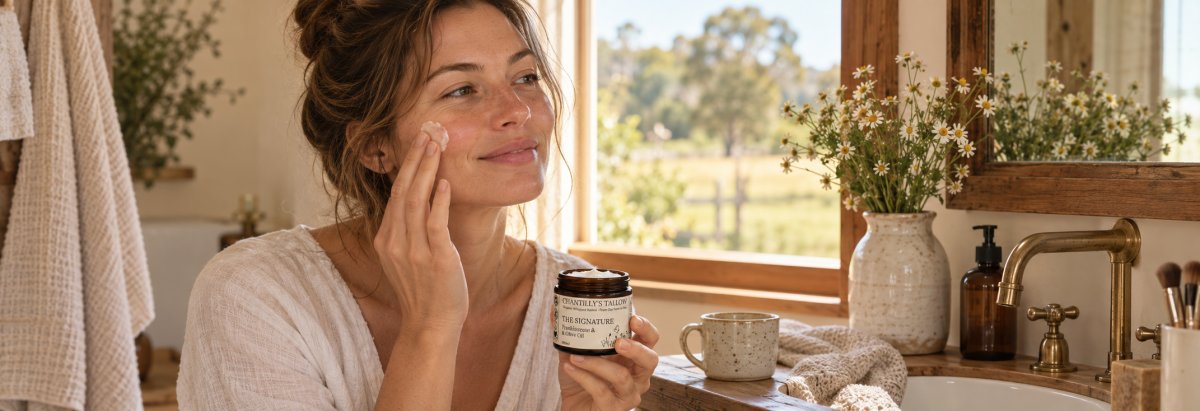
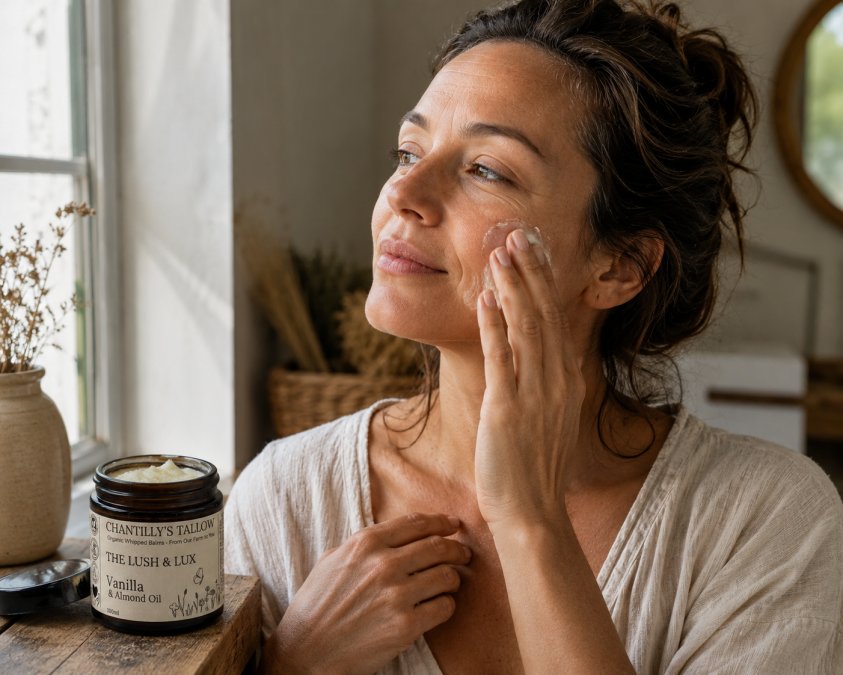
Tallow balm is potent, so a little goes a long way. For the face, use roughly a pea sized amount. Warm it between your fingertips (tallow softens quickly with body heat), then press it gently into damp skin. For the body, use slightly more and apply the same way. Don't rub it in aggressively; pressing and patting allows it to absorb without disrupting your barrier further.
When to use: morning, evening, or both
Most people use tallow balm at night, when your skin's repair processes are most active. Evening application also avoids potential interaction with sunscreen or makeup. If you have very dry skin or active eczema, twice daily often produces faster results. If you have oily skin, once daily at night is usually sufficient.
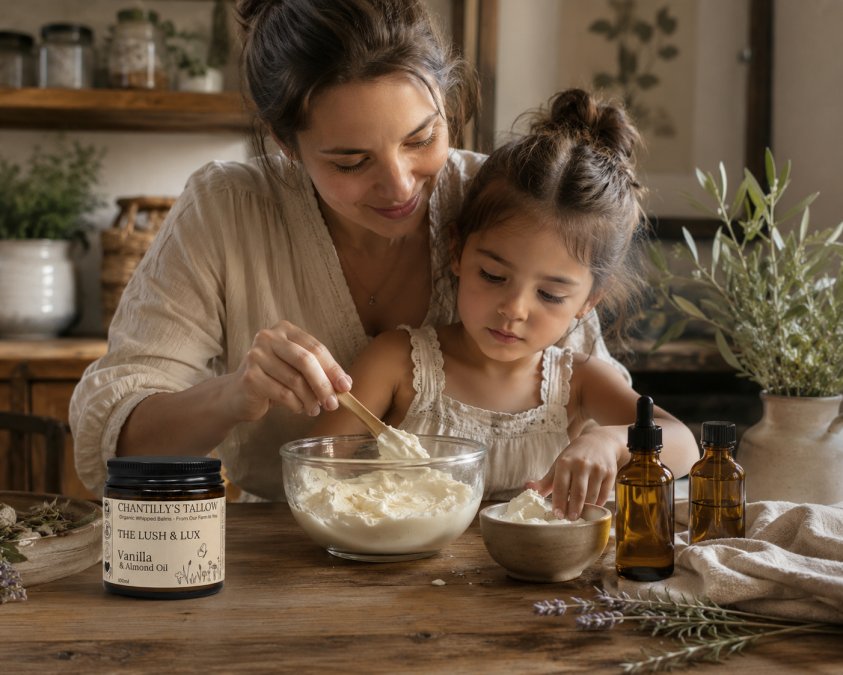
A whipped tallow lends itself to am and pm use as it's consistency is lighter and can go well under makeup depending which type of makeup you use, especially the ones with lighter oils like sweet almond oil or jojoba oil. Allow it to soak in fully, before applying makeup. The tallow can add a glow that lasts the day.
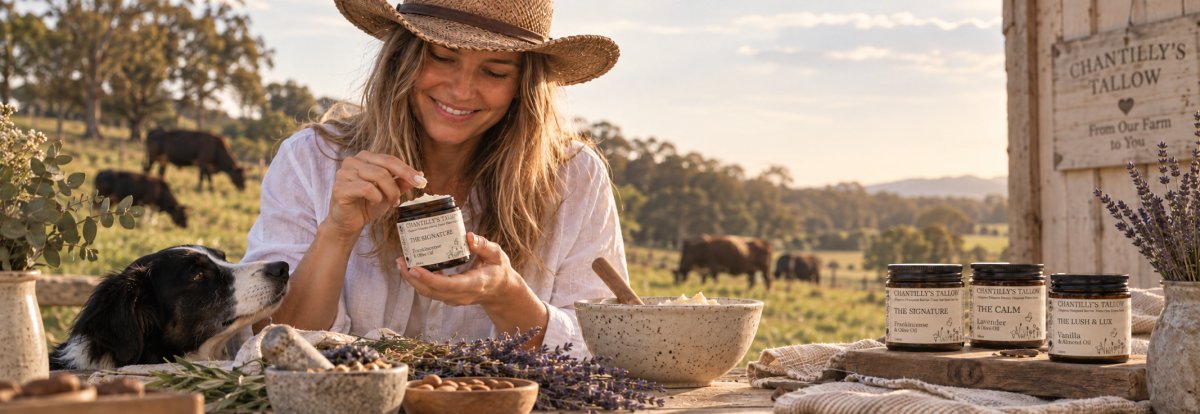
Some tallow producers like chantilly's Tallow recommend am and pm balms and formulate them accordingly.
Combining tallow with other skincare actives
Tallow plays well with most skincare ingredients as an excellent final step, apply it last, after any serums or treatments, to seal everything in. Avoid layering tallow under heavy occlusive products like petroleum jelly. You only need one occlusive layer. If you use retinol or other potentially irritating actives, tallow is an excellent buffer that reduces irritation while maintaining efficacy.
Tallow Balm Shelf Life and Storage Conditions
How long tallow balm stays fresh
Properly stored tallow balm remains stable for 12-18 months. Pure tallow lasts longer than tallow blended with essential oils, which can oxidise more quickly. Rancidity is the main concern, when fats oxidise, they develop an unpleasant smell and lose their skin-supporting properties.
Proper storage to prevent rancidity
Store your tallow balm in a cool, dark place, ideally below 28°C. A bathroom cabinet away from direct sunlight and heat sources is ideal. Keep the lid sealed between uses; exposure to air speeds oxidation. If you notice your tallow developing a rancid smell, it's oxidised and should be discarded. In warm climates, consider storing tallow in the refrigerator, it will harden slightly but this extends shelf life significantly without affecting efficacy.
DIY Tallow Balm Recipe for Dry Skin
Ingredients and equipment needed
Making tallow balm at home requires rendered tallow (beef fat) as your base. For a basic formula, you'll need:
- 100g rendered grass-fed tallow
- 15g organic olive oil
- 10g organic jojoba oil
- 5g organic macadamia oil
- Optional: 5-10 drops of essential oil (lavender, frankincense, or chamomile work well for sensitive skin)
Equipment: double boiler or heat-safe bowl over a pot of water, glass jars with lids, whisk or electric mixer, thermometer, and cheesecloth or fine mesh strainer if rendering tallow yourself.
Step-by-step rendering and whipping instructions
Step 1: Render the tallow. Cut grass-fed beef suet into small chunks and place in a slow cooker or heavy-bottomed pot over low heat. The fat will gradually melt over 2-4 hours. Strain through cheesecloth into glass jars and allow to cool completely.
Step 2: Melt the tallow gently. Use a double boiler to heat 100g of rendered tallow to approximately 50-55°C. Don't exceed 60°C, as high heat damages the vitamins and fatty acids you're trying to preserve.
Step 3: Add complementary oils. Once the tallow is melted, add the olive, jojoba, and macadamia oils. Stir gently to combine. If using essential oils, add them now and mix thoroughly.
Step 4: Cool to room temperature. Pour the mixture into glass jars and allow it to cool to room temperature (about 20°C). This takes 30-45 minutes.
Step 5: Whip for texture (optional). Once cooled but still soft, transfer to a bowl and whip with an electric mixer for 3-5 minutes to create a light, fluffy texture that's easier to apply.
Step 6: Store in glass jars. Transfer to clean glass jars with tight-fitting lids. Label with the date. Store in a cool, dark place. Shelf life is 12-18 months.
Professional illustration showing Overhead for tallow balm for dry skin
Grass-Fed vs. Conventional Tallow: What Matters
Nutrient density and sourcing transparency
100% Grass-fed cattle produce tallow with measurably higher levels of fat-soluble vitamins and beneficial fatty acids. Grass-fed tallow contains more CLA, which has anti-inflammatory properties, and higher levels of omega-3 fatty acids relative to omega-6, which supports skin barrier health. Conventional tallow from grain-fed cattle is cheaper but nutritionally inferior.
Sourcing transparency matters because it's the only way to verify you're actually getting 100% grass-fed tallow. Ask producers: Where do the cattle graze? Are they rotated on pasture? What do they eat during winter? Legitimate producers can answer these questions.
Ethical and sustainable farming practices
100% Grass-fed cattle raised on well-managed pasture improve soil health, sequester carbon, and support biodiversity. When you choose grass-fed tallow, you're supporting farming practices that regenerate land rather than deplete it. Cattle raised on biodiverse pasture produce tallow with a richer micronutrient profile than those in feedlots.
Attribute | Grass-Fed Tallow | Conventional Tallow |
|---|---|---|
Vitamin A content | Higher | Lower |
CLA levels | 3-5x higher | Baseline |
Omega-3 to omega-6 ratio | More balanced | Omega-6 dominant |
Anti-inflammatory potential | Stronger | Weaker |
Environmental impact | Regenerative | Extractive |
Sourcing transparency | Usually available | Often vague |
Is Tallow Safe for the Face and Sensitive Skin
Dermatologist perspective on tallow
Dermatologists increasingly recognise tallow as a legitimate skin barrier repair tool. Tallow's lipid profile matches skin's natural composition, so it doesn't trigger immune responses the way some plant oils do. The main dermatological concern is contamination or rancidity. If tallow is poorly stored or rendered, it can harbour bacteria or oxidised compounds that irritate skin.
Tallow is not a treatment for severe dermatitis or eczema; it's a barrier support tool. If your skin condition is active and severe, consult a dermatologist.
Patch testing and introducing tallow gradually
Even though tallow is well-tolerated, patch testing is sensible if you have extremely reactive skin. Apply a small amount to your inner arm or behind your ear and wait 24 hours. When you first introduce tallow to your routine, start with small amounts every other night for the first week. If you experience redness or itching that persists beyond the first week, discontinue use. True allergic reactions to tallow are rare, but if you're allergic to beef, you should avoid it.
At Chantilly's Tallow, we've spent years understanding how grass-fed tallow restores skin health at the barrier level. Our handcrafted balms are made from tallow sourced directly from our own farm, ensuring both nutrient density and ethical sourcing. If you're dealing with chronic dry skin, eczema, or simply looking for a natural, biocompatible moisturiser, tallow offers what commercial products can't: a lipid profile your skin actually recognises. Find Your Balm and experience the difference honest, small-batch skincare makes.
Frequently Asked Questions
Q: Why do dermatologists rarely recommend tallow balm when it's so effective for dry skin?
A: Tallow balm is relatively new to mainstream dermatology because it sits outside conventional pharmaceutical skincare channels. However, the science is sound: tallow's fatty acid profile closely mirrors the skin barrier, and clinical observations show it reduces moisture loss and supports healing in eczema and psoriasis. Dermatologists increasingly recognise tallow as a legitimate option, especially for patients who react poorly to synthetic moisturisers. The hesitation often stems from lack of large-scale clinical trials, not from evidence of harm.
Q: How long does tallow balm shelf life last, and how should I store it?
A: Properly rendered and stored tallow balm lasts 12–18 months. Store it in a cool, dark place away from direct sunlight and heat; a cupboard or cool bedroom works well. Keep the lid sealed between uses to prevent oxidation. Refrigeration extends shelf life further but is not necessary. Signs of spoilage include off-odours, discolouration, or a grainy texture. Grass-fed tallow is more stable than conventional tallow because the fatty acid profile is less prone to rancidity.
Q: What makes grass-fed tallow better for dry skin than plant-based moisturisers?
A: Grass-fed tallow contains a unique blend of saturated and monounsaturated fatty acids that closely matches the skin's natural lipid barrier, making it bioavailable and non-comedogenic. It also contains fat-soluble vitamins A, D, E, and K in their most absorbable forms. Plant-based oils like coconut or sunflower are beneficial but often require emulsifiers or water to stabilise, which can irritate reactive skin. Tallow works alone, making it ideal for those with severe sensitivities or compromised barriers.
Q: Can tallow balm replace my entire skincare routine, or do I still need serums and cleansers?
A: Tallow balm is a moisturiser and barrier protector, not a complete routine. You still need a gentle cleanser suited to your skin type and, if desired, targeted treatments like vitamin C or niacinamide serums. Tallow works beautifully as the final step in a routine because it seals in hydration and actives. For minimalist routines, many people use only a cleanser and tallow balm with excellent results, especially for dry or eczema-prone skin. The key is finding what your skin needs, not following a rigid formula.
Q: How do I know if a tallow balm is truly from grass-fed, organic cattle?
A: Look for suppliers who provide transparency about sourcing: farm location, farming practices, and certifications. Reputable producers often share details about their cattle and rendering process. Ask questions directly—ethical producers are happy to answer. Some brands display certifications or third-party audits. Avoid vague claims like 'natural' without specifics. Direct-from-farm brands like Chantilly's Tallow, which source from their own Gippsland farm, offer full traceability and eliminate middlemen, making sourcing verification straightforward.