 listicle
Best Tallow Skincare for Reactive Skin: 2026 Guide
Table of Contents
- Why Tallow Skincare Works for Reactive Skin
- Quick Comparison: Top Tallow Balms for Sensitive Skin
- How We Evaluated These Tallow Skincare Products
- 1. Chantilly's Tallow: Farm-to-Face Grass-Fed Balm
- How to Patch Test Tallow Skincare
- Tallow Balm Shelf Life and Storage
- Tallow vs Jojoba Oil for Face
- Frequently Asked Questions
Last Updated: September 9, 2026
Reactive skin demands a different standard from skincare. Tallow skincare is one of the few categories built around a single ingredient that mirrors the lipid profile of human skin, which is why it has moved from farmhouse remedy to a serious option for eczema-prone and sensitive complexions. At Chantilly's Tallow, we craft our balms on a Gippsland farm from 100% grass-fed beef tallow.
The best tallow skincare for reactive skin shares three traits: a pure grass-fed base, an unscented or minimally fragranced formula, and transparent sourcing you can verify. Grass-fed and grass-finished sources carry a richer concentration of vitamins A, D, E and K, plus conjugated linoleic acid, which supports the skin barrier and calms redness. Below, we cover the patch test and storage habits that make the difference between relief and disappointment.
Why Tallow Skincare Works for Reactive Skin
Tallow skincare works because its fatty acid composition closely resembles the sebum human skin produces naturally. This bio-compatibility means the skin barrier recognises the lipids and absorbs them readily, rather than treating them as a foreign occlusive layer.
The practical benefit is reduced transepidermal water loss. A 2023 review in the International Journal of Molecular Sciences on skin barrier lipids confirms that restoring the skin's natural lipid ratio is central to managing conditions like eczema and dermatitis. Tallow delivers that ratio in a single ingredient, without the preservatives and synthetic emulsifiers that often trigger reactive flare-ups.
Tallow acts as both an emollient and an occlusive: it softens the skin while forming a breathable barrier that locks moisture in, which is exactly what reactive, compromised skin needs to begin repairing itself.
Quick Comparison: Top Tallow Balms for Sensitive Skin
When comparing tallow balms, the deciding factors are rarely texture alone, they are the invisible details that determine whether a product calms or triggers. The criteria that matter most for sensitive complexions include the comedogenic rating and sourcing transparency that most guides overlook.
Product | Base | Texture | Comedogenic Rating | Scent Profile | Sourcing Transparency | Best For |
|---|---|---|---|---|---|---|
Chantilly's Tallow | 100% grass-fed, organic | Whipped creamy lightweight balm, absorbs easily | 0-1 | Scented to Unscented types | Fully verifiable, own farm in Gippsland, pasture-to-pot traceability | All ages, from newborns to adults |
Eat My Face Original | Grass-fed tallow | Classic balm | 0-1 (minimal pore congestion risk) | Unscented | Brand states grass-fed, but no third-party verification or farm details published | Budget-conscious, eczema-prone |
Anml Unscented Whipped | Grass-fed tallow | Light, whipped | 0-1 (whipping adds air, not oils) | Unscented | Brand states grass-fed; limited public documentation of farm sources | Non-greasy daily wear |
True Origin Deep Hydration Whip | Grass-fed tallow | Whipped | 0-1 | Completely essential oil-free | Brand states grass-fed; no third-party certification mentioned | Extreme fragrance sensitivity |
Primally Pure Tallow | Grass-fed tallow | Un whipped balm | 0-1 (pure tallow base) | Unscented, but check variant-specific ingredients | Brand publishes sourcing stories, though not farm-level traceability | Barrier repair |
Why the Comedogenic Rating Matters for Reactive Skin
A comedogenic rating measures how likely an ingredient is to clog pores, scored from 0 (no clogging) to 5 (highly likely to clog). Pure, high-quality beef tallow typically scores 0 to 1, meaning it does not block pores when properly refined. This is counterintuitive to anyone who has avoided tallow because they assume "fat equals breakouts."
Poorly rendered tallow that retains impurities, connective tissue, or excess free fatty acids can behave differently on the skin, potentially increasing congestion risk. This is why sourcing transparency is not just an ethical preference, it is a functional requirement for reactive skin.
How to Verify Grass-Fed Claims Yourself
Most brands say "grass-fed." Few prove it. For reactive skin users, the difference matters because grass-fed and grass-finished tallow carries a higher concentration of conjugated linoleic acid (CLA) and fat-soluble vitamins A, D, E and K compared to grain-fed sources.
Three practical checks you can run on any brand:
- Look for "grass-finished" not just "grass-fed." An animal can be grass-fed for part of its life and grain-finished. Grass-finished means the animal never ate grain. This distinction changes the fatty acid profile.
- Ask for the farm name and location. A brand that names its farm, as we do with our Gippsland property, invites scrutiny. A brand that says "sourced from Australia" without specifics is hiding something.
- Check the colour and smell. High-quality grass-fed tallow is cream to light yellow with a mild, clean scent. Dark yellow tallow is not always an indicator of grass fed it’s also rendering methods and cattle breed specific. A strong beefy odour suggests poor rendering or older fat, which can introduce impurities that reactive skin will notice.
The Fragrance Trap in "Natural" Skincare
A significant number of tallow balms marketed for sensitive skin still contain essential oils. Lavender, tea tree, and citrus oils are common additions, sometime used to mask odours of tallow. For reactive skin, these are not benign, essential oils are among the most frequent triggers for allergic contact dermatitis.
If your skin has reacted to "natural" balms before, check the ingredient list for anything beyond tallow and possibly olive oil, jojoba, or macadamia. Those three carrier oils are generally well-tolerated, but essential oils, botanical extracts, and synthetic fragrance are red flags for reactive skin.
if a tallow producer has reviews for their unscented balms being loved, that’s a good sign their balms are odour free and scents are adding experience and additional qualities not masking.
The Whipped vs. Firm Texture Trade-Off
Texture is not just preference, it affects how the balm performs on your skin. Firm balms sit on the skin longer, providing extended occlusive barrier support, but can be heavier and greasier Whipped balms incorporate air during processing, which changes the feel but does not dilute the tallow's fatty acid content. The trade-off is storage stability: whipped balms can collapse in warm conditions above 32 degrees Celsius. the texture will change. While firm balms hold their structure better.
If you live in a warm climate or apply moisturiser before makeup, you can store you whipped balm in the fridge as whipped texture may be more practical. If you prefer a thicker only overnight barrier repair, a firm balm will be as suitable to deliver deeper lipid support. It really comes down to preference and use. @chantillys tallow we love whipped balm’s for their day and night versatility.
How We Evaluated These Tallow Skincare Products
We consider ingredient purity, comedogenic rating, fragrance load, and sourcing transparency. A balm can be perfectly moisturising yet still fail a reactive skin user if it contains essential oils, botanical extracts, or a tallow source that is not verifiably grass-fed.
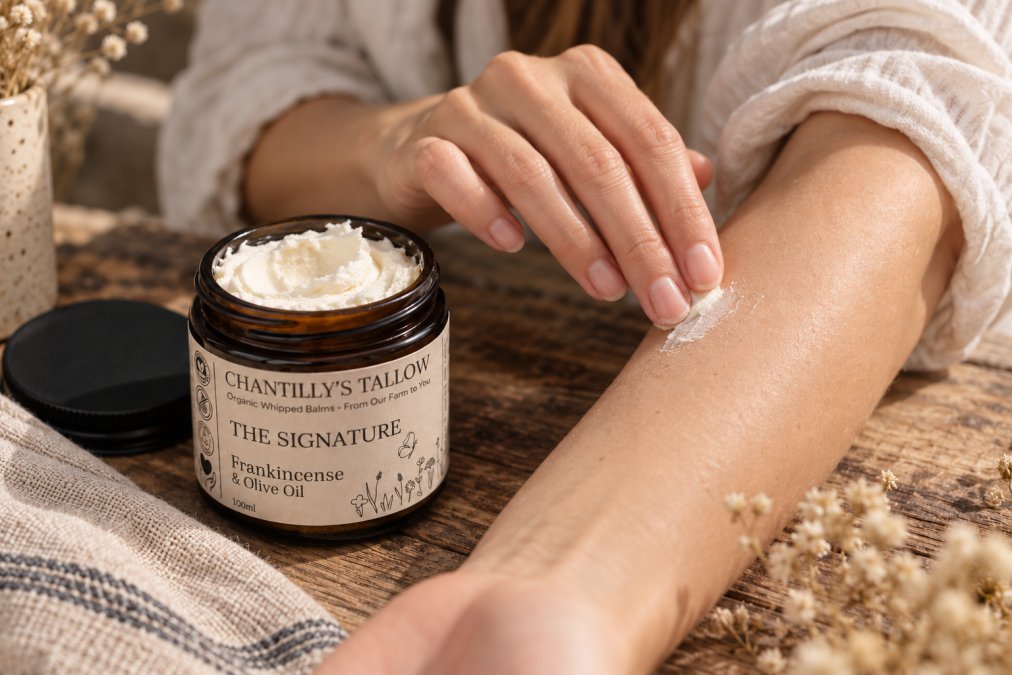
1. Chantilly's Tallow: Farm-to-Face Grass-Fed Balm
Chantilly's Tallow controls every step, from pasture to pot. The balm is handcrafted in small batches on our own Gippsland farm using 100% grass-fed, organically-raised beef tallow, with no middlemen and no mystery in the supply chain.
Because the tallow is bio-compatible with human skin cell structure, it supports healing for problematic conditions like eczema and psoriasis while offering natural anti-ageing qualities for mature skin. It is safe for all ages, from newborns to adults, and works as a minimalist post-shave balm.
The honest limitation is the texture. A pure tallow balm in a cooler environment is firm at room temperature and needs a moment to melt between your fingers before application. That is a small trade for the certainty of knowing nothing else is in the jar.
How to Patch Test Tallow Skincare
Patch testing is the single most important step for reactive skin. Apply a small amount of balm to a clean area of skin on your inner forearm, about the size of a coin. Leave it uncovered and check the area twice daily for any redness, itching, or irritation.
Continue this for five to seven days. Reactive skin can show a delayed response, so a single 24-hour test is not enough to rule out a reaction. If the area stays clear, introduce the balm to your face gradually.
Tallow Balm Shelf Life and Storage
A pure tallow balm is remarkably stable, but it is not immortal. Unopened, a well-made balm stored in a cool, dark place will keep for up to two years. Once opened, aim to use it within 12 months. Tallow does not require refrigeration, but heat is its enemy: store it below 28°C and keep the lid sealed when not in use to prevent oxidation.
Signs your balm has turned include a rancid smell, a change in colour to yellow, or a grainy texture that does not melt at skin temperature. If you see any of these, replace it.
Tallow vs Jojoba Oil for Face
The comparison between tallow and jojoba oil for face care comes down to barrier support versus lightweight hydration. Jojoba is technically a wax ester, not an oil, and it closely mirrors human sebum, making it a fine non-comedogenic moisturiser for oily or combination skin. Tallow goes further for reactive and dry skin: its fatty acid profile provides the lipid building blocks a compromised barrier needs to repair itself, while jojoba mainly sits on the surface to prevent moisture loss.
The more useful question for reactive skin users is how each fits into a routine that already includes active ingredients like Vitamin C or retinol.
Layering Tallow with Active Ingredients
Most tallow guides stop at "apply to clean skin." For anyone using serums, this is unhelpfully vague: tallow's occlusive nature changes how actives perform.
Vitamin C (L-ascorbic acid): Vitamin C works best at a low pH (below 3.5) to penetrate the skin. Tallow is slightly acidic, typically around pH 5.5-6.5, which means applying tallow before Vitamin C can raise the skin's surface pH and reduce the active's efficacy. The better sequence is: cleanse, apply Vitamin C, wait 10-15 minutes for it to absorb, then seal with tallow.
Retinol: Retinol converts to retinoic acid in the skin, a process that can cause irritation, especially for reactive skin. Tallow's barrier-supporting lipids can buffer that irritation, but timing matters. Most dermatologists recommend alternating nights: retinol one night, tallow the next, or applying retinol and waiting 20 minutes before a thin layer of tallow as an occlusive seal.
Niacinamide: Unlike Vitamin C and retinol, niacinamide plays well with occlusive balms. It is pH-stable and can be layered directly under tallow without losing efficacy.
The Jojoba Option for Active-User Routines
If you use multiple active ingredients daily, jojoba may be the better daytime moisturiser because it absorbs quickly and does not create the same occlusive barrier that can trap actives against the skin. A common pattern is:
- Morning: Cleanse, apply Vitamin C, follow with jojoba oil as a lightweight seal.
- Evening: Cleanse, apply retinol (2-3 nights per week), wait, then apply tallow as an overnight barrier.
This split routine gives you the antioxidant protection of Vitamin C during the day without the greasy feel, and the deep lipid repair of tallow at night.
Why Tallow Wins for Reactive Skin (and When It Does Not)
For eczema-prone or very dry skin, tallow is the more nourishing choice because it supplies the ceramide-like lipids that a compromised barrier lacks. Jojoba, while non-comedogenic and well-tolerated, does not deliver the same depth of fatty acid support.
There are two scenarios where jojoba is the better option:
- You are in the middle of a retinol purge. When skin is actively peeling and inflamed from retinoid use, even a pure tallow balm can feel occlusive and trap heat. Jojoba's lighter texture allows the skin to breathe while still providing moisture.
- You live in a humid climate. In high humidity, tallow's occlusive barrier can feel heavy and may contribute to heat rash or miliaria in sensitive individuals. Jojoba's lighter touch is more comfortable.
The Combination Approach
Many reactive skin users find that a combination works best. Jojoba as a daytime serum provides antioxidant protection and lightweight hydration. Tallow as a night-time barrier delivers the lipid building blocks for repair while you sleep.
If you are comparing them for reactive skin, start with tallow. Its barrier-repair action addresses the root cause of sensitivity, not just the symptom of dryness. But keep jojoba in your routine for the days when your skin needs less occlusion and more breathability.
Frequently Asked Questions
Why don't dermatologists recommend tallow skincare?
Some dermatologists hesitate to recommend tallow because clinical studies on animal fats in skincare are limited compared with synthetic moisturisers. However, tallow's fatty acid profile closely matches human sebum, and many patients with reactive skin report relief from eczema and dryness. The key is choosing a grass-fed, unscented product and patch testing first. If your dermatologist is open to natural options, discuss trying a small amount on a discreet area before applying it to larger regions.
What is the best tallow skincare for eczema-prone skin?
For eczema-prone skin, look for a 100% grass-fed, unscented tallow balm with minimal ingredients. Chantilly's Tallow avoids essential oils and synthetic fragrances that can trigger flares. The natural vitamins A, D, E and K in grass-fed tallow support skin barrier repair, while the occlusive nature of the balm locks in moisture. Always patch test on your inner forearm for 48 hours before applying to eczema patches.
How should I store tallow balm to maintain its shelf life?
Tallow balm typically lasts 12 to 24 months when stored correctly. Keep it in a cool, dry place away from direct sunlight and heat sources. A bathroom cabinet is fine, but avoid leaving it near a hot shower. In warm Australian summers, the balm may soften; that is normal and does not affect quality. If you notice an off smell or change in texture, discard it. Use clean, dry fingers or a spatula each time to prevent introducing bacteria or water.
Can I use tallow skincare alongside my prescription eczema creams?
Yes, but introduce it gradually. Apply your prescription treatment first, allow it to absorb for 10-15 minutes, then layer a small amount of tallow balm over the top as an occlusive seal. This locks in the active ingredients while providing additional barrier support. Some users find tallow helps reduce their reliance on stronger steroid creams, but always discuss changes with your dermatologist first. Stop use if you notice increased irritation or redness.