 listicle
Organic Tallow Balm for Face: A 2026 Review
Table of Contents
- Why Organic Tallow Balm for Face Is Worth the Switch
- Tallow vs Jojoba Oil for Face: Which Works Better?
- The Science: Vitamins, Fatty Acids, and Your Skin Barrier
- How to Apply Tallow Balm to Face for Best Results
- What to Look For in an Organic Tallow Balm
- Tallow Balm Shelf Life and Storage: Keeping It Fresh
- Our Verdict: Is It the Right Choice for Your Skin?
- Frequently Asked Questions
Last Updated: September 5, 2026
Why Organic Tallow Balm for Face Is Worth the Switch
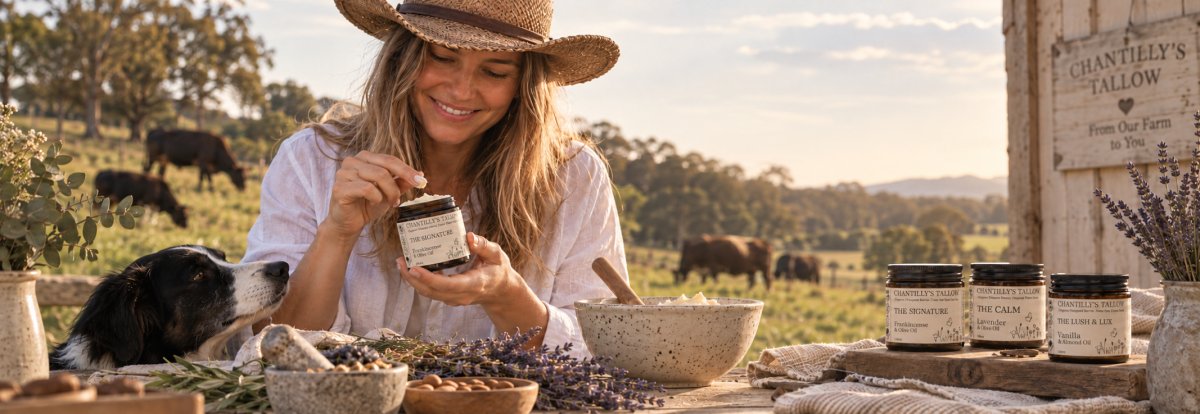
For anyone who has spent years cycling through expensive creams promising relief that never arrives, the idea of applying beef fat to your face sounds counterintuitive. Yet organic tallow balm for face is one of the most bio-compatible moisturisers available, because its lipid profile closely mirrors the sebum our own skin produces. At Chantilly's Tallow, we craft small-batch balms from 100% grass-fed beef tallow raised on our own Gippsland farm, and we believe this traditional ingredient rebalances even the most frustrated skin.
The reason tallow works where synthetic moisturisers fail comes down to chemistry. Tallow is rich in vitamins A, D, E and K, along with omega 7 fatty acids and palmitoleic acid, a compound naturally present in youthful skin but depleted as we age. Rather than sitting on the surface, these nutrients absorb deeply to support skin barrier repair and reduce transepidermal water loss. For those managing eczema, rosacea or simply dry winter skin, this means genuine relief rather than temporary surface smoothing.
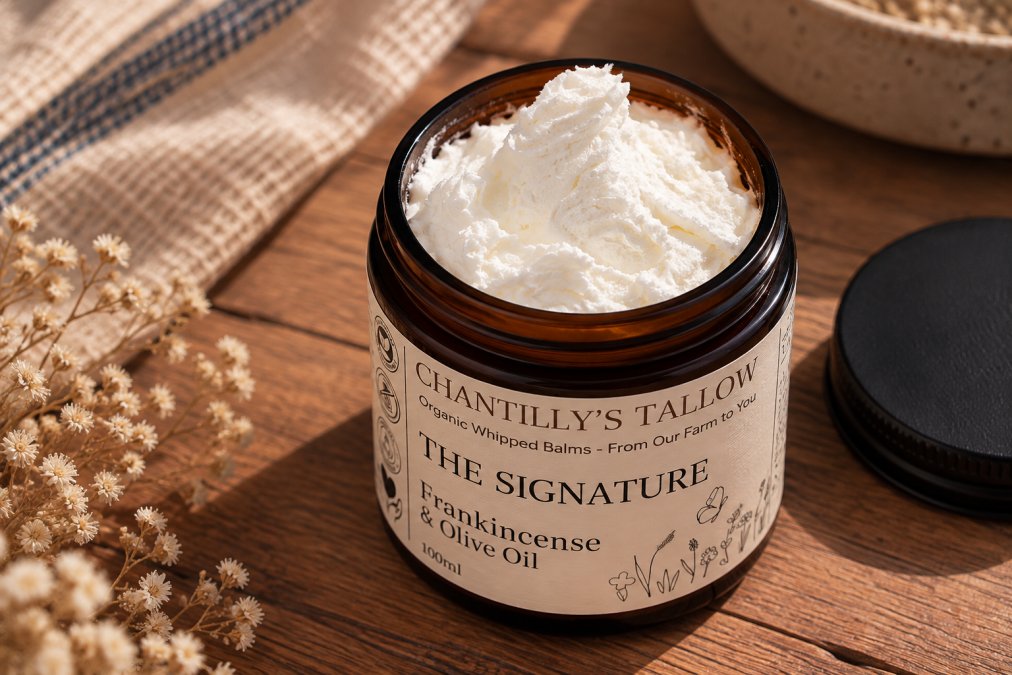
Below, we will walk through how tallow compares to plant oils, the science behind its effectiveness, and exactly how to use it for the best results. We will also cover what separates a genuine organic product from a marketing claim, plus how to store your balm so it stays fresh.
Tallow vs Jojoba Oil for Face: Which Works Better?
The short answer: jojoba oil is a fine lightweight moisturiser, but tallow is a complete skin food. Jojoba is technically a wax ester, not an oil, and it does mimic human sebum closely enough to trick the skin into balanced production. However, jojoba lacks the fat-soluble vitamins and the full fatty acid spectrum that tallow delivers.
Consider what your skin barrier actually needs. The outermost layer of your skin is composed of ceramides, cholesterol and free fatty acids, and it is this lipid matrix that keeps moisture in and irritants out. Tallow provides these building blocks in a form your skin recognises instantly. Jojoba offers lightweight hydration but little in the way of barrier repair. For a young person with naturally balanced skin, jojoba might suffice. For anyone dealing with sensitivity, flaking or the first signs of fine lines, tallow is the more nutrient-dense choice.
Where jojoba wins is texture and speed of absorption. It is non-comedogenic and vanishes quickly, making it a decent daytime option under makeup. Tallow, by contrast, takes a few minutes to fully absorb and leaves a subtle, protective sheen. Many people find a hybrid approach works best: a drop of jojoba in the morning, tallow balm for face at night.
The Comedogenic Question: Will Tallow Clog My Pores?
This is the most common hesitation we hear, and it deserves a straight answer. The comedogenic scale rates ingredients from 0 (non-comedogenic) to 5 (highly likely to clog pores). Pure beef tallow typically scores a 1-2 on this scale, meaning it has a low likelihood of clogging pores. For context, coconut oil scores a 4, cocoa butter a 4, and wheat germ oil a 5. Jojoba oil scores a 2, similar to tallow.
The rating, however, is only half the story. Comedogenicity is about the potential to block a follicle, but the effect depends on your skin's current condition and the quality of the ingredient. High-quality, grass-fed tallow is rich in linoleic acid, an omega-6 fatty acid that is often deficient in the sebum of acne-prone skin. Replenishing linoleic acid can help normalise sebum production and reduce the likelihood of blockages. This is why many people with acne-prone skin find that a minimal amount of tallow actually improves their skin's texture, whereas a heavy, synthetic cream might trigger breakouts.
A common pattern is that breakouts occur not from the tallow itself, but from over-application. Using more than a pea-sized amount creates a thick, impermeable layer that can trap dead skin cells. The key is to use a tiny amount and press it in, allowing the skin to absorb what it needs. If you are prone to congestion, start by using it only at night and on damp skin, which helps it spread more thinly.
Comparison | Tallow Balm | Jojoba Oil |
|---|---|---|
Lipid profile | Full spectrum, includes omega 7 | Single wax ester |
Vitamins | A, D, E, K | Minimal |
Barrier repair | Strong | Mild |
Comedogenic rating | 1-2 (Low) | 2 (Low) |
Best time to use | Night or dry skin | Day or oily skin |
The Science: Vitamins, Fatty Acids, and Your Skin Barrier
Tallow's reputation is not folk wisdom; it is grounded in how human skin biology functions. Grass-fed beef tallow contains approximately 50-55% saturated fats, which provide the structural integrity your skin barrier needs to keep moisture in and environmental aggressors out. The remaining unsaturated fats, including oleic acid and the prized omega 7 palmitoleic acid, deliver anti-inflammatory and antioxidant-rich support.
Vitamin A encourages cellular turnover, which helps soften the appearance of fine lines and wrinkles over time. Vitamin D supports the skin microbiome and calms reactive complexions. Vitamin E acts as a preservative and antioxidant, while vitamin K assists with circulation and the fading of dark spots. This combination is why tallow is often described as a complete skincare ingredient: it nourishes rather than merely coats.
For those with compromised barriers, the difference is tangible. When your barrier is weakened, moisture escapes and irritants enter, triggering the inflammation behind eczema and rosacea flares. Tallow helps restore that barrier because its fatty acids are structurally similar to what your skin already produces. As documented in dermatological research on skin barrier function and lipid replacement, topical application of skin-identical lipids supports barrier recovery more effectively than occlusive ingredients like petroleum jelly.
How to Apply Tallow Balm to Face for Best Results
Application technique matters more than most people realise. A common mistake is scooping out too much product and smearing it on thickly, which wastes balm, and will struggle to fully absorb. Start with a pes sized amount and add more as needed, the amount your skin optimally wants will change seasonally. Chantilly's customer survey results show one 100ml jar lasts customers 8-12 weeks on average. A little goes a long way.
Start with clean, slightly damp skin. Warmth helps tallow melt, so rub a pea-sized amount between your fingertips until it softens into an oil. Press the balm into your face with gentle, upward strokes rather than rubbing. Focus on dry patches, the delicate under-eye area, and your neck. Give it two to three minutes to absorb before applying sunscreen or makeup.
For best results, use tallow balm for face as the final step in your evening routine. The overnight hours are when your skin performs most of its repair work, and a nutrient-dense occlusive layer supports that process. In the morning, a single cleanse will remove any residue. If your skin is very reactive, patch test on your jawline for three nights before applying all over. Those transitioning from a stripped, over-exfoliated routine sometimes experience a brief adjustment period as their skin rebalances its own oil production.
:::\tip Warm the balm between your fingertips for five seconds before applying. This transforms the solid butter into a silky oil that spreads evenly and absorbs faster, so you use less product and avoid that heavy feeling. :::
The Sensory Experience: What to Expect
Let's address the elephant in the room: the smell. High-quality, grass-fed tallow that has been properly rendered and whipped has a very mild, clean scent that is often described as neutral or slightly nutty. It should not smell strongly of beef or roast dinner. If a product has a strong, gamey odour, it is a sign of poor rendering or lower-quality fat. Any scent dissipates within 30-60 seconds of application, leaving no lingering fragrance on your skin.
If you are still sensitive to the natural aroma, some balms incorporate complementary ingredients. Look for products that use a small amount of a high-quality essential oil like lavender, rose, or sweet orange to mask the scent. Alternatively, a touch of raw honey or vanilla extract can add a subtle, warm sweetness. Be cautious with essential oils if you have very reactive skin, as they can be irritating. A pure, unscented balm is always the safest starting point.
The texture is another adjustment. Tallow balm is solid at room temperature but melts on contact with skin. It feels rich and emollient, not greasy. After absorption, it leaves a soft, conditioned finish rather than a sticky or tacky residue. This is the feeling of your skin barrier being properly nourished.
Layering Tallow with Serums and SPF
A common question is where tallow fits in a multi-step routine. Because tallow is an occlusive ingredient, it works best as the final step in your evening routine, after water-based serums. Apply your serum (like hyaluronic acid or niacinamide) to damp skin, wait for it to absorb, then seal everything in with a thin layer of tallow. This locks in the active ingredients and prevents overnight moisture loss.
In the morning, the approach is different. Tallow formulated as a night balm can be too heavy to layer under sunscreen or makeup. Lighter oil bases like sweet almon oil can give tallow an extra lightness more suited to under make up day use. Use a tiny amount and apply it at least 10 minutes before your sunscreen to give it time to form a stable layer.
What to Look For in an Organic Tallow Balm
Not all tallow is created equal, and the sourcing gap between a genuine organic product and a commodity render is enormous. The first thing to verify is the animal's diet. 100% Grass-fed, organically raised cattle produce tallow with a superior lipid profile and higher antioxidant content than grain-fed animals. Look for explicit certification or, better yet, a farm you can trace the product to.
The ingredient list is your next clue. A pure balm should contain tallow and perhaps one or two complementary oils such as olive oil, jojoba or macadamia. Beware of products padded with water, synthetic fragrances, or preservatives, all of which dilute the tallow and can trigger sensitive skin. Whipped tallow has a light, mousse-like texture that is easier to spread, while unwhipped balm is denser and more intensive. Both work; the choice comes down to personal preference and skin needs.
Ethical sourcing matters too. Small-batch production, direct farm-to-consumer models, and transparent farming practices indicate a producer who stands behind their product. At Chantilly's Tallow, every jar is handcrafted on our own Gippsland farm, from cattle we raise ourselves, with no middlemen and no mystery ingredients. If a product cannot tell you where its tallow comes from, that is a reason to keep looking. The Australian Consumer Law guidance on product claims requires businesses to substantiate their marketing, so certifications and farm traceability are fair questions to ask any seller.
Tallow Balm Shelf Life and Storage: Keeping It Fresh
Pure tallow balm is naturally shelf-stable thanks to its high saturated fat content, but it will eventually oxidise. Proper storage extends its life significantly. Keep your balm in a cool, dry place away from direct sunlight and store it below 28C to maintain its whipped texture. A bathroom cabinet is usually fine, but avoid leaving it on a sunny windowsill or near a heater.
An unopened jar of tallow balm typically lasts 12 to 18 months from production. Once opened, regular use within 6 to 9 months is recommended, though most people finish a 100ml jar well before that. If your balm develops a rancid or sour smell, or the colour darkens noticeably, discard it. A fresh balm has a mild, clean scent that disappears within moments of application.
:::\warning Do not introduce water into the jar. Dipping wet fingers in creates a breeding ground for bacteria and accelerates spoilage. Use a dry spatula or clean fingertips, and always replace the lid tightly after use. :::
Our Verdict: Is It the Right Choice for Your Skin?
Tallow balm is not a miracle cure, but it is the closest thing to a complete moisturiser that most skin types will ever meet. For anyone battling chronic dryness, sensitivity, or the visible signs of ageing, the nutrient density and bio-compatibility of 100% grass-fed tallow make it a superior choice to most commercial creams. The key is choosing a genuinely ethically sourced product and using it consistently.
Chantilly's Tallow is our top recommendation because we control every step from pasture to jar. Our balm is made from 100% grass-fed, organically-raised beef tallow, handcrafted in small batches on our Gippsland farm. It is bio-compatible with human skin, free from synthetic additives, and safe for everyone from newborns to grandparents. If you are ready to give your skin the nourishment it has been missing, explore our range and find the balm that suits your routine.
Frequently Asked Questions
Does tallow balm really work on the face?
Yes. Tallow balm is rich in vitamins A, D, E, and K, along with omega fatty acids that closely mirror your skin's own sebum. This compatibility helps repair the skin barrier and lock in hydration, which can reduce dryness and soothe conditions like eczema. Many users report a visible difference in skin softness and elasticity within a few weeks of consistent use.
Is tallow balm non-comedogenic?
Tallow has a comedogenic rating of 1-2 out of 5, meaning it has a low risk of clogging pores. This is because its fatty acid profile is very similar to human sebum. However, everyone's skin is different. If you are prone to breakouts, start by using a small amount on a patch of skin and observe how your face reacts before applying it all over.
How should I store my organic tallow balm to maintain its quality?
To preserve its nutrient profile, store your tallow balm in a cool, dry place away from direct sunlight. We recommend keeping it under 28°C to prevent it from melting. When stored correctly, a balm with natural antioxidants can last 12 to 18 months. To extend its life, avoid introducing water into the jar and always use clean, dry fingers or a spatula.
Can tallow balm help with fine lines and wrinkles?
Tallow balm provides intense hydration, which plumps the skin and temporarily softens the appearance of fine lines. Its high concentration of vitamins A and E also supports collagen production and protects against free radical damage, which are key factors in premature ageing. While it is not a miracle cure, it is an effective, natural part of an anti-aging routine.
Why do some dermatologists advise against tallow?
Some dermatologists are cautious because of a lack of large-scale clinical studies and potential for pore blockage in acne-prone individuals. However, many are open to it as a natural option due to its biocompatibility and anti-inflammatory properties. It is always best to patch test and consult with your own dermatologist, especially if you have a chronic skin condition.
Frequently Asked Questions
Q: Does tallow balm really work on the face?
A: Yes. Tallow balm is rich in vitamins A, D, E, and K, along with omega fatty acids that closely mirror your skin's own sebum. This compatibility helps repair the skin barrier and lock in hydration, which can reduce dryness and soothe conditions like eczema. Many users report a visible difference in skin softness and elasticity within a few weeks of consistent use.
Q: Is tallow balm non-comedogenic?
A: Tallow has a comedogenic rating of 1-2 out of 5, meaning it has a low risk of clogging pores. This is because its fatty acid profile is very similar to human sebum. However, everyone's skin is different. If you are prone to breakouts, start by using a small amount on a patch of skin and observe how your face reacts before applying it all over.
Q: How should I store my organic tallow balm to maintain its quality?
A: To preserve its nutrient profile, store your tallow balm in a cool, dry place away from direct sunlight. We recommend keeping it under 28°C to prevent it from melting. When stored correctly, a balm with natural antioxidants can last 12 to 18 months. To extend its life, avoid introducing water into the jar and always use clean, dry fingers or a spatula.
Q: Can tallow balm help with fine lines and wrinkles?
A: Tallow balm provides intense hydration, which plumps the skin and temporarily softens the appearance of fine lines. Its high concentration of vitamins A and E also supports collagen production and protects against free radical damage, which are key factors in premature ageing. While it is not a miracle cure, it is an effective, natural part of an anti-aging routine.
Q: Why do some dermatologists advise against tallow?
A: Some dermatologists are cautious because of a lack of large-scale clinical studies and potential for pore blockage in acne-prone individuals. However, many are open to it as a natural option due to its biocompatibility and anti-inflammatory properties. It is always best to patch test and consult with your own dermatologist, especially if you have a chronic skin condition.