 listicle
Tallow Balm for Deep Hydration: A 2026 Review
Table of Contents
- Tallow Balm for Deep Hydration: Quick Comparison
- How Tallow Balm Delivers Deep Hydration
- Is Tallow Balm Good for Sensitive Skin?
- Tallow Balm Shelf Life and Storage
- Best Ingredients to Pair With Tallow Balm
- How to Apply Tallow Balm for Deep Hydration
- Common Mistakes That Undermine Deep Hydration
- Conclusion
- Frequently Asked Questions
Last Updated: September 10, 2026
Tallow Balm for Deep Hydration: Quick Comparison
Tallow balm for deep hydration works by mimicking the lipids your skin already produces, which is why it absorbs rather than sits on top. At Chantilly's Tallow, we render grass-fed beef tallow on our Gippsland farm and whip it into small-batch balms for exactly this purpose. Below, we compare how different options approach hydration, barrier repair and texture, then break down the application protocol most people get wrong.
Balm | Base | Texture | Best For |
|---|---|---|---|
Chantilly's Tallow | 100% grass-fed organic tallow | Whipped, Creamy Fluffy & light small-batch | All ages, sensitive and reactive skin, mature & hormonal skin |
Primally Pure Everything Balm | Grass-fed tallow | Firm, multi-purpose | Dry patches, travel |
Ancestral Cosmetics Tallow Balm | Grass-fed suet | Whipped | Traditional lipid replenishment |
Moose's Tallow Balm | Grass-fed tallow | Dense | Measurable hydration gains |
Hearth and Homestead Tallow Balm | Grass-fed tallow | Light, fluffy | Those who dislike greasy balms |
How Tallow Balm Delivers Deep Hydration
Deep hydration from tallow comes down to lipid compatibility. The fat profile of grass-fed beef tallow sits close to the lipids in human skin, so it reinforces the skin barrier instead of merely coating it. That is the difference between a balm that feels soft for an hour and one that changes how your skin behaves over weeks.
Essential Fatty Acids and Fat-Soluble Vitamins in Grass-Fed Tallow
Grass-fed tallow carries a lipid profile rich in oleic, palmitic and stearic acids, plus the fat-soluble vitamins A, D, E and K that skin can actually use. These are bioavailable in a fat base in a way they are not in water-based creams. Vitamin A supports normal cell turnover, while vitamin E contributes antioxidant protection. A common mistake is assuming all tallow is equal: grain-finished fat has a different fatty acid balance from fat raised on pasture, which is why sourcing transparency matters more than the label on the jar.
Occlusive, Humectant and Emollient: What Tallow Actually Does
Tallow is primarily an occlusive and emollient, not a humectant. That distinction explains most application errors. An occlusive forms a sealing layer that slows trans-epidermal water loss, and an emollient softens and smooths the surface. A humectant, by contrast, pulls water into the skin. Tallow does the first two jobs exceptionally well and leaves the third to whatever you apply underneath.
Is Tallow Balm Good for Sensitive Skin?
Tallow balm suits most sensitive skin because it is chemically simple. Fragrance, preservatives and synthetic emulsifiers cause many reactions, and a well-made tallow balm contains none of them. But 'sensitive skin' is not one condition, and the honest answer depends on which sensitivity you have.
Why Tallow Rarely Triggers Reactive Skin
The lipid profile is the reason. Grass-fed tallow is dominated by oleic, palmitic and stearic acids plus fat-soluble vitamins A, D, E and K, molecules your skin already recognises and uses. There is no added fragrance, no essential oil blend, no synthetic emulsifier and no preservative system, which removes the four most common triggers in a single step. A common pattern among people with eczema-prone or dermatitis-prone skin is that tallow feels gentler than fragranced creams, though no topical is guaranteed non-reactive and anyone with a diagnosed condition should patch test first and keep their treating practitioner informed.
The Comedogenic Question Most Guides Skip
Tallow sits in the middle of the comedogenic scale, roughly a 1-2 out of 5 on the standard 0-5 rating. That is lower than coconut oil (about 4) and higher than jojoba (about 2, but structurally closer to sebum). In practice this means tallow is unlikely to clog pores for most people, but it is not comedogenic-zero, and anyone prone to congestion should treat it as a patch-test candidate rather than a guaranteed safe bet. The rating also shifts with what is blended in: a tallow balm cut with coconut oil inherits coconut oil's higher score, while one blended with jojoba or macadamia stays closer to the base fat's profile. Read the full ingredient list, not just the front of the jar.
Sourcing and Rendering: What 'Grass-Fed' Actually Means
Sourcing transparency matters more than the label. Grain-finished fat has a different fatty acid balance from fat raised on pasture, and the rendering method changes the finished balm as much as the feed does.
When you are checking a 'grass-fed' claim, look for a named farm or region, a stated rendering method, and a batch or lot number. A jar that names none of these is asking you to take the claim on faith.
A Sensible Patch-Test Protocol
For reactive skin, choose an unscented, additive-free balm and test on the inner forearm for three nights before using it on the face. Apply a pea-sized amount to damp skin, cover with a light bandage if you want to mimic facial occlusion, and note any redness, itching or heat within 24 hours. If the forearm is clear after three nights, move to the jawline for two nights, then the full face. This staged approach isolates the balm from everything else in your routine and tells you whether a reaction is the tallow or something you layered with it.
Tallow Balm Shelf Life and Storage
Unopened tallow balm keeps for around 12 months; once opened, plan to use it within 6 to 9 months. Fat oxidises, and heat accelerates that process. Store your jar below 28°C in a dark cupboard, away from the bathroom windowsill and the stovetop. Refrigeration extends freshness and firms the texture, which some people prefer in summer. Expect the balm to soften and even liquefy above roughly 30°C; that is normal and does not spoil it, but repeated melting and cooling shortens shelf life. If the balm smells sharp, waxy or rancid rather than faintly beefy and clean, discard it. Always scoop with clean, dry fingers or a small spatula to keep water out of the jar, since introduced moisture is what turns a stable fat rancid.
Best Ingredients to Pair With Tallow Balm
The best partners for tallow are humectants and lightweight oils that add what tallow cannot. Tallow is primarily an occlusive and emollient, so it seals and softens but does not attract water. Pair it with something that does, and you get the full hydration sequence: water in, water held, water sealed.
Humectants to Apply Under Tallow
- Raw honey: a natural humectant that draws water into the skin; apply a thin layer first, then seal with balm.
- Aloe vera gel: cooling and water-rich, ideal under balm for irritated or sun-exposed skin.
- Glycerin-based serums: a workhorse humectant that pulls water from the air and the deeper skin layers; a few drops under balm is enough.
Lightweight Oils That Layer Cleanly
- Jojoba oil: mimics sebum and layers cleanly under tallow without heaviness.
- Macadamia oil: rich in palmitoleic acid, it absorbs quickly and suits mature or dry skin.
- Olive oil: a traditional emollient that softens rough areas like elbows, heels and cuticles.
Layering With Actives: The Sequence Most Guides Get Wrong
Tallow is occlusive, which means it can increase the penetration of whatever sits beneath it. That is helpful for humectants and harmful for strong actives.
- Vitamin C serums: apply first on clean, dry skin, wait 60 seconds, then seal with tallow. The occlusive layer can drive absorption and, for some people, sting, start with a lower-strength serum and a thin balm layer.
- Retinol and retinoids: apply as directed, wait until fully dry, then seal with a thin layer of tallow only if your skin has already tolerated both separately. Never introduce retinol and tallow on the same night.
- Prescription topicals: apply as directed, wait for it to dry fully, then seal with balm only if your practitioner confirms it will not increase absorption.
- Strong acids (AHA/BHA): avoid sealing with tallow in the same step; the occlusive layer can amplify irritation. Use the acid on its own night.
A Simple Order of Operations
Water-based serums and humectants go on first, oil-based actives and retinoids next, and tallow balm last as the sealing layer. If you are testing a new product, do not layer tallow over it on the same night, you will not know which one caused a reaction. Introduce one new variable at a time, and give each two weeks before adding the next.
How to Apply Tallow Balm for Deep Hydration
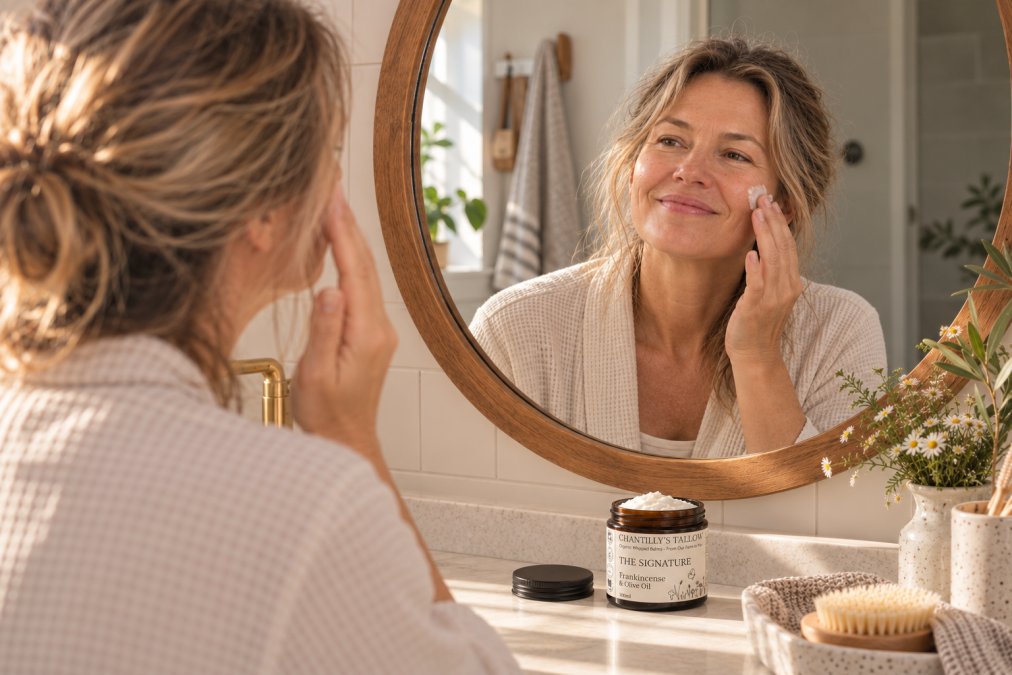
Apply tallow balm to damp skin, using a pea-sized amount warmed between your fingertips. Damp skin application is the single biggest factor in results: the water is what you are sealing in. Work in upward strokes, press rather than rub, and give it two minutes to settle before makeup. For the body, apply straight after a shower while skin is still humid. For compromised areas like cracked heels or eczema patches, apply a thicker layer at night and cover with cotton socks or gloves.
Layering Tallow Balm With Other Actives
Sequence matters more than product choice. Water-based serums and humectants go on first, oil-based actives and retinoids next, and tallow balm last as the sealing layer. If you use a prescription topical, apply it as directed, wait for it to dry fully, then seal with balm only if your practitioner confirms it will not increase absorption. Never layer tallow over an active on the same night you are testing a new product; you will not know which one caused a reaction.
Common Mistakes That Undermine Deep Hydration
Most disappointing results trace back to one of five errors:
- Applying balm to completely dry skin, so you trap dryness instead of moisture
- Using too much; a pea-sized amount covers the whole face
- Storing the jar on a warm windowsill, accelerating rancidity
- Layering over strong actives and mistaking irritation for purging
- Expecting overnight change; barrier repair is a weeks-long process although many customers share feeling improvements after a few days.
Conclusion
Getting deep hydration from tallow is less about the product and more about the protocol: damp skin, the right amount, correct layering and honest storage. Chantilly's Tallow makes this straightforward with 100% grass-fed organic tallow, handcrafted in small batches on our Gippsland farm, bio-compatible with human skin and free from synthetic additives. It is safe for all ages, from newborns to adults, and built for moisture re-balancing rather than marketing claims. Browse the full range and Find Your Balm.
Frequently Asked Questions
Does tallow balm actually hydrate skin?
Yes, and it does so in two ways. Tallow balm acts as an occlusive, forming a sealing layer that slows trans-epidermal water loss and locks moisture into the skin. It also supplies fat-soluble vitamins A, D, E and K plus essential fatty acids that support skin barrier repair over time. Applied to damp skin, it traps existing moisture rather than simply sitting on the surface, which is why many users notice softer, more supple skin within days of consistent use.
Can I use tallow balm on my face every day?
Daily use is fine for most people, including on the face. Start once daily in the evening on damp skin and give your skin a week to adjust before adding a morning application. If you are prone to congestion, use a thin layer and focus on drier areas like cheeks and around the eyes. Tallow balm is non-comedogenic for many users, but everyone's skin differs, so watch how yours responds during the first fortnight.
Is tallow balm good for sensitive skin and eczema-prone skin?
Tallow balm suits many sensitive skin types because its lipid profile closely mirrors human sebum, so the skin recognises and accepts it. It is typically free from synthetic fragrances and harsh additives that trigger reactions. For eczema-prone skin, plain unscented formulas are the safest starting point, and patch testing on the inner forearm for 24 hours is sensible. If your skin is highly reactive, choose a balm with the shortest ingredient list you can find.
How should I store tallow balm and how long does it last?
Store tallow balm in a cool, dark place below 28°C, away from direct sunlight and heat, and keep the lid sealed to prevent oxidation. In those conditions an unopened jar typically keeps for 12 to 24 months, and around 6 to 12 months once opened. If your balm contains raw honey or botanical infusions, treat the shorter end as your guide. A change in smell or a grainy, separated texture means it is past its best.
How does tallow compare to plant-based moisturisers?
Plant-based moisturisers often rely on humectants like glycerin to draw water into the skin, while tallow works mainly as an occlusive and emollient that seals moisture in and replenishes skin-native lipids. The two approaches complement each other: a humectant serum under a tallow balm gives both hydration and a sealing layer. Tallow's advantage is its bio-compatible fat profile, which many users find more soothing on compromised or cracked skin than lighter plant oils.