
 how-to
Tallow Skincare for Rosacea: A 2026 Guide
Table of Contents
- Why Tallow Skincare Is Gaining Attention for Rosacea Relief
- The Benefits of Grass-Fed Tallow for Skin Barrier Repair
- Understanding Tallow's Fatty Acid Profile and Anti-Inflammatory Action
- How to Apply Tallow Balm to Sensitive Skin
- Tallow Balm Shelf Life and Storage: What You Need to Know
- Sourcing and Processing: How to Choose a Quality Tallow Balm
- Tallow Skincare vs. Prescribed Rosacea Treatments
- Your Next Steps to Calmer Skin
- Frequently Asked Questions
Last Updated: September 8, 2026
Why Tallow Skincare Is Gaining Attention for Rosacea Relief
Rosacea affects millions of Australians, yet most prescribed creams suppress symptoms rather than address underlying skin barrier damage. Tallow skincare for rosacea relief works differently: it feeds the barrier the lipids it needs to repair itself.
At Chantilly's Tallow, we handcraft balms from 100% grass-fed beef tallow on our Gippsland farm. Tallow is bio-compatible with human skin because our sebum shares a remarkably similar lipid profile, so skin recognises it as familiar material and absorbs it deeply rather than leaving it on the surface.
The growing interest reflects a shift toward natural skincare that works with the skin microbiome. People are tired of the steroid cycle: relief, then rebound, then stronger steroids. Tallow offers a path focused on long-term barrier restoration.
The Benefits of Grass-Fed Tallow for Skin Barrier Repair
The skin barrier is your first line of defence against irritants, pollution, and environmental triggers that spark rosacea flare-ups. When it weakens, transepidermal water loss increases, leaving skin dehydrated, reactive, and prone to inflammation.
Grass-fed tallow is rich in the fatty acids your barrier needs to rebuild: oleic acid for deep penetration, palmitic acid which occurs naturally in human skin, and stearic acid for structural integrity. It also carries vitamin A for cell turnover, vitamin D for the skin's immune response, and vitamin E for antioxidant protection.
Tallow's dual action as both emollient and occlusive makes it particularly effective for rosacea-prone skin. As an emollient, it softens dry, flaky patches; as an occlusive, it forms a breathable layer that locks in moisture and prevents water loss. This directly addresses the compromised barrier underlying most rosacea symptoms.
Understanding Tallow's Fatty Acid Profile and Anti-Inflammatory Action
Inflammation is the engine of rosacea, and tallow's fatty acid composition helps quiet it. The key players are linoleic acid and oleic acid, which work in opposition to regulate the skin's inflammatory response.
Linoleic acid, an omega-6 fatty acid, maintains the skin barrier's integrity; skin deficient in it becomes dry, scaly, and more permeable to irritants. Oleic acid acts as a penetration enhancer, helping beneficial compounds reach deeper skin layers.
Many people find that consistent use of tallow can help reduce redness, not because tallow masks redness but because it supports the skin barrier, which can reduce the impact of irritants. When the barrier heals, baseline inflammation drops and flare-ups become less frequent and severe.
This is where tallow skincare for rosacea relief differs from approaches that merely soothe symptoms: it addresses structural weakness, reducing skin reactivity over time rather than calming an active flare. For those managing other dermatological conditions, this barrier-first approach often provides compounding benefits.
How to Apply Tallow Balm to Sensitive Skin
Application technique matters as much as the product itself when your skin is easily triggered. The goal is to introduce tallow gradually, allowing skin to adapt. For rosacea-prone skin, a staged approach is non-negotiable.
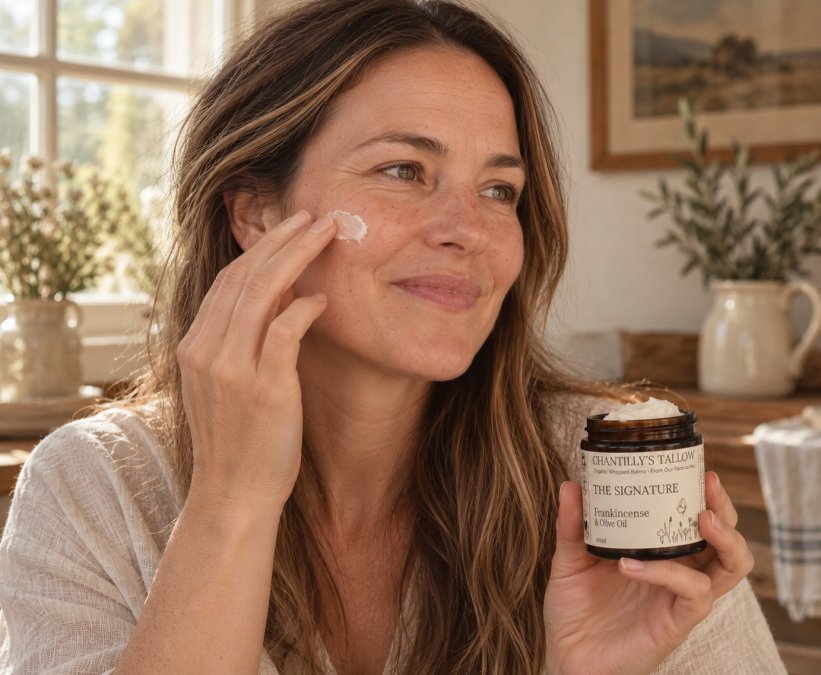
Step 1: The 48-Hour Patch Test Protocol for Reactive Skin
A standard patch test is often insufficient for rosacea because reactivity varies by facial region. Here is a more rigorous, safe protocol for highly reactive skin.
Day 1: The Initial Contact Test
Choose a small, discreet area that mirrors your facial reactivity, such as the side of the neck below the jawline or behind the ear. Clean with your usual gentle cleanser, pat dry, apply a rice-grain-sized amount of tallow, and leave it for at least 12 hours.
Day 2: The 24-Hour Observation
After 24 hours, inspect for redness, swelling, itching, burning, or papules or pustules. Rosacea reactions can be delayed, so 24 hours is the minimum. If any symptoms appear, wash with lukewarm water and discontinue. If calm, proceed.
Day 3: The Facial Half-Face Test
Apply a pea-sized amount of tallow to only one side of your face, for example, your left cheek and left side of your nose, leaving the right side untreated. This side-by-side comparison reveals subtle changes in redness, texture, or sensitivity. Monitor for another 24 hours.
Day 4: Assessment and Decision
Compare both sides in natural light. If the treated side shows no increase in redness, no new breakouts, and feels comfortable, proceed with full-face application. If in doubt, wait another 24 hours. This staged protocol minimises flare-up risk and gives a clear answer about your skin's tolerance.
Step 2: Cleansing and Application
Start with clean, slightly damp skin; tallow absorbs best when skin is hydrated, so apply within a few minutes of cleansing. Warm a pea-sized amount between your fingertips, then press it gently into your skin rather than rubbing. Avoid the delicate eye area unless you know the balm is non-irritating.
Step 3: Layering and Ingredient Interactions
Rosacea skin is often managed with active ingredients, so layering matters. Tallow is an occlusive, so if you use prescription treatments like azelaic acid or metronidazole, apply them first and wait 20 to 30 minutes before applying tallow. This prevents trapping the active ingredient on the surface, which could increase irritation.
Avoid layering tallow with retinoids or alpha-hydroxy acids (AHAs) in the same application; these need a specific pH environment, and tallow's heavy lipid matrix can interfere with their efficacy and increase irritation risk. Instead, use tallow in the morning and actives at night, or vice versa.
For the first week, use tallow once daily, preferably at night. If no irritation occurs, increase to twice daily; many users find morning and evening application produces the best moisture retention and soothing results.
Tallow Balm Shelf Life and Storage: What You Need to Know
Unlike commercial moisturisers packed with preservatives, natural tallow balm has a finite life, and proper storage affects both its longevity and safety on sensitive skin.
An unopened tallow balm stored in a cool, dark place remains fresh for 12 to 18 months. Once opened, use it within 9-12 months. Heat accelerates oxidation, while light degrades beneficial vitamins.
Store your balm below 28 degrees Celsius, away from direct sunlight and bathroom humidity; in warmer months, a pantry or bedroom drawer is often better than a bathroom cabinet. If the balm softens in summer heat, that's normal, it re-solidifies when cooled without losing effectiveness.
You can store your balm in the fridge to extend its shelf life. It will need a little more warming up between fingertips prior to application if it’s been sitting in the fridge. This is a great option for warmer climates.
Sourcing and Processing: How to Choose a Quality Tallow Balm
Not all tallow is created equal; the difference between a balm that heals and one that triggers a flare-up often comes down to sourcing and rendering methods. For rosacea-prone skin, the margin for error is slim, so understanding the processing chain is your best defence against impurities.
The Critical Difference: Rendered Fat vs. Skincare-Grade Tallow
The term 'tallow' can refer to two very different products. The first is simply rendered fat, raw adipose tissue melted down to separate pure fat from connective tissue and impurities. This suits cooking or soap making, but not necessarily your face.
Skincare-grade tallow undergoes additional processing to remove trace proteins, blood solids, and other impurities that often cause reactions in sensitive skin. It is typically rendered multiple times, filtered through fine mesh, and sometimes centrifuged for a smooth, odourless, pure result. A balm that smells strongly 'beefy' or feels gritty likely hasn't been refined to skincare grade.
Sourcing: Grass-Fed and Pasture-Raised Matters
100% Grass-fed, organically-raised cattle produce tallow with a superior fatty acid profile. Pasture-raised cattle yield tallow richer in omega-3 fatty acids and conjugated linoleic acid (CLA), both of which support the skin's anti-inflammatory response. Grain-fed cattle produce tallow with more omega-6 fatty acids, which can be pro-inflammatory in excess.
Processing: Low-Temperature vs. High-Heat Rendering
Rendering method matters equally. Low-temperature rendering, below 100 degrees Celsius, preserves fat-soluble vitamins (A, D, E) and natural antioxidants. High-heat industrial processing destroys these nutrients and oxidises fatty acids; oxidised fats can generate free radicals on the skin, contributing to the very inflammation you're trying to calm.
The 'Whipping' Question and Additives
Many tallow balms are whipped for a fluffy and lighter texture. Both are suitable for use on Rosaces prone skin. Be wary of essential oils, botanical extracts, or synthetic fragrances, common irritants for rosacea-prone skin. The safest balm for reactive skin has fewer ingredients: pure, grass-fed tallow & a skin friendly cold pressed oil like olive, jojoba or macadamia.
Questions to Ask Before You Buy
Ask these questions before buying any tallow balm:
- Are the cattle grass-fed and pasture-raised for their entire lives. post weening?
- Is the tallow rendered at low temperatures to preserve nutrients?
- Has the tallow been filtered or refined to skincare grade, or is it basic rendered fat?
- Are there any additives, fragrances, essential oils, or preservatives?
- Is the balm whipped or solid set?
- Can the producer trace the product back to a specific farm and batch?
At Chantilly's Tallow, every batch is handcrafted in small quantities on our own farm, so we guarantee the source from pasture to jar. This transparency matters when you're putting a product on reactive skin.
Tallow Skincare vs. Prescribed Rosacea Treatments
Prescribed rosacea treatments, such as topical metronidazole or azelaic acid, work by suppressing the inflammatory response. They can be highly effective for acute flare-ups, and we're not suggesting you abandon anything your dermatologist has prescribed.
Tallow plays a different role: rather than suppressing inflammation, it addresses the structural weakness that makes skin prone to it. Think of prescribed treatments as firefighting and tallow as fireproofing, one handles the immediate emergency, the other reduces future incidents.
Many people use both: prescribed treatments during active flare-ups and tallow daily as a maintenance balm to support barrier health between episodes. If you're considering adding tallow to a routine that includes prescription medication, discuss it with your dermatologist first. The Australasian College of Dermatologists guidance on rosacea management emphasises the importance of a consistent, gentle skincare routine alongside any medical treatment.
Your Next Steps to Calmer Skin
Starting any new skincare product with rosacea takes courage. You've likely been burned before, literally and figuratively, by products that promised relief and delivered irritation.
The path forward is simple but requires patience. Begin with a patch test, introduce tallow slowly, and watch how your skin responds over several weeks rather than days. Barrier repair is not instant, but the cumulative effect of consistent, gentle nourishment is profound.
For those ready to try tallow skincare for rosacea relief, look for a balm you can trace to its source, made from grass-fed tallow with no additives or fragrances. Our handcrafted balms at Chantilly's Tallow are made in small batches from 100% grass-fed, organically-raised beef tallow, direct from our Gippsland farm to your skin, no middlemen, no mystery ingredients, just pure honest skincare, You Can Trust.
Frequently Asked Questions
Will tallow skincare get rid of rosacea?
Tallow skincare is not a cure for rosacea, but it can help manage symptoms for many people. The fatty acid profile in grass-fed tallow closely matches human skin lipids, which supports skin barrier repair and reduces transepidermal water loss. This can lower skin reactivity and redness over time. However, rosacea is a complex dermatological condition with many triggers. What works for one person may not work for another, so treat tallow as part of a broader management strategy rather than a guaranteed fix.
Why don't dermatologists recommend beef tallow for sensitive skin?
Most dermatologists are trained to recommend products with extensive clinical trial data, which tallow lacks. There is also a perception issue: patients often hear 'rendered beef fat' and assume it will clog pores. In practice, tallow's lipid profile is non-comedogenic and bio-compatible with human skin. The absence of clinical studies does not mean tallow is ineffective. It means you should proceed carefully, patch test first, and monitor your skin's response over several weeks.
Can I use tallow balm alongside my prescribed rosacea medication?
Many people do, but timing matters. Apply your prescribed treatment first and wait for it to absorb fully, usually 10 to 15 minutes, before applying tallow balm on top. Tallow acts as an occlusive layer, which can help lock in the active ingredients. However, if your prescription contains ingredients that increase sun sensitivity, adding an occlusive layer may intensify that effect. Check with your dermatologist before combining treatments, especially if you use topical steroids or antibiotics.
How should I store tallow balm to maintain its shelf life?
Proper storage keeps tallow balm fresh for 12 to 18 months. Keep it in a cool, dark place away from direct sunlight and heat sources, which can degrade the fatty acids. A bathroom cabinet is usually fine, but avoid leaving it on a windowsill or near a heater. Always use clean, dry fingers or a spatula to scoop out the balm. Introducing water or food particles into the jar can encourage bacterial growth and shorten its shelf life.