 ultimate-guide
Is Tallow Safe for Newborns? A Parent's Guide
Table of Contents
- Is Tallow Safe for Newborns? What Parents Need to Know
- Benefits of Grass-Fed Beef Tallow for Baby Skin
- Tallow Balm for Baby Eczema, Nappy Rash, and Cradle Cap
- How to Patch Test Skincare for Newborns Before Full Use
- Tallow vs Jojoba Oil for Baby and Sensitive Skin
- What to Look for in a Quality Tallow Balm for Newborns
- Tallow Balm Shelf Life and Storage
- Frequently Asked Questions
Last Updated: August 28, 2026
Is Tallow Safe for Newborns? What Parents Need to Know
Tallow is safe for newborns when it is pure, grass-fed, and free from synthetic additives, essential oils, and preservatives. Newborn skin is structurally different from adult skin, the stratum corneum is thinner and more permeable, meaning topical products absorb more readily and irritants reach deeper tissue faster. This is precisely why the composition of a skincare product matters so much in those first weeks of life.
Beef tallow, the rendered fat from cattle, has been used as a skin emollient for centuries. What makes it particularly relevant for newborn skincare is its lipid profile. Tallow's fatty acid composition closely mirrors the sebum that human skin produces naturally, making it genuinely bio-compatible in a way that many synthetic moisturisers are not. The Australasian College of Dermatologists resource on skin barrier function notes that maintaining the integrity of the skin barrier is foundational to preventing inflammatory skin conditions, particularly in infants.

Professional illustration showing parent and gently and applying concepts for is tallow safe for newborns
Below, we cover the benefits, the risks to watch for, how to patch test correctly, and what to look for in a product that is genuinely safe for newborn use.
Benefits of Grass-Fed Beef Tallow for Baby Skin
Grass-fed beef tallow offers a fat-soluble vitamin and fatty acid profile that few plant-based alternatives can match for newborn skin nourishment.
Fat-Soluble Vitamins and the Skin Barrier
Tallow rendered from grass-fed cattle contains meaningful levels of vitamins A, D, E, and K. Vitamin A supports cell turnover and helps maintain the integrity of the skin barrier. Vitamin D is involved in immune modulation and inflammation control at the skin surface. Vitamin E acts as an antioxidant, protecting skin cells from oxidative stress. Vitamin K supports the skin's natural healing processes.
These vitamins are fat-soluble, meaning they are delivered in a form the skin can actually absorb. The bioavailability of nutrients in tallow is meaningfully higher than in water-based formulations, where fat-soluble compounds are often poorly absorbed.
Why the Lipid Profile Matters for Newborn Skin
The lipid profile of grass-fed beef tallow is dominated by oleic acid, palmitic acid, and stearic acid, the same fatty acids that make up a significant portion of human sebum. Conjugated linoleic acid, present in grass-fed tallow, also has documented anti-inflammatory properties relevant to reactive skin.
This similarity to the skin's own lipids means tallow integrates into the skin's existing lipid matrix, supporting hydration from within rather than simply sealing moisture in. For newborns, whose skin barrier is still developing, this distinction matters. Tallow is also non-comedogenic at typical application amounts, which addresses a common concern about applying fat-based products to infant skin.
Tallow Balm for Baby Eczema, Nappy Rash, and Cradle Cap
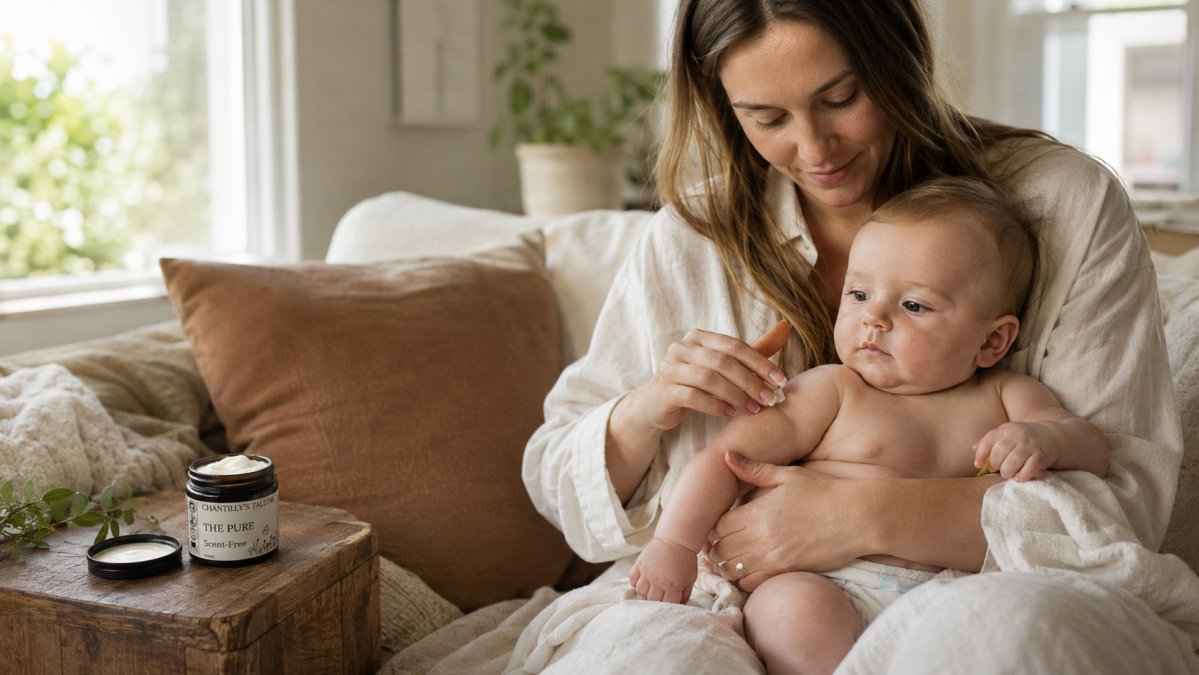
The three most common infant skin conditions parents ask about in relation to tallow balm are baby eczema, nappy rash, and cradle cap. Each involves a compromised or inflamed skin barrier, and each responds well to emollient therapy.
Professional illustration showing is tallow safe for newborns
Baby eczema is characterised by dry, inflamed, and often itchy patches of skin. The underlying issue is a disrupted skin barrier that allows moisture to escape and irritants to penetrate. Tallow balm replenishes the lipids that the barrier is failing to retain. Many parents report improvement in eczema symptoms when switching from synthetic commercial moisturisers to a pure tallow balm, particularly when the commercial product contained fragrances, preservatives, or alcohol.
Nappy rash occurs when skin is repeatedly exposed to moisture, friction, and the enzymes in urine and stool. A thick, occlusive balm creates a physical barrier between the skin and these irritants. Tallow balm is well-suited to this application because it is stable, long-lasting on the skin, and free from the preservatives that can further irritate already-inflamed skin.
Cradle cap, a form of seborrhoeic dermatitis, involves a build-up of oily, scaly patches on the scalp. Gentle massage with a small amount of tallow balm can help loosen and lift these scales without stripping the scalps natural oils. The key is using a minimal amount and ensuring the balm is essential oil free, as many essential oils are contraindicated for infants under three months.
According to the Royal Children's Hospital Melbourne clinical guidance on eczema management, regular emollient use is the cornerstone of eczema management in infants, with the goal of restoring and maintaining the skin barrier. Tallow balm, when pure and additive-free, fits squarely within this emollient-first approach.
How to Patch Test Skincare for Newborns Before Full Use
Patch testing skincare for newborns is a non-negotiable step before applying any new product across a large area of skin.
Step-by-step patch test protocol for newborns:
- Choose a small, discreet area of skin such as the inner forearm or behind the knee.
- Apply a very small amount of the product, roughly the size of a grain of rice, to the test area.
- Leave the area uncovered and unwashed for 24 hours.
- Observe the site at 30 minutes, 4 hours, 12 hours, and 24 hours after application.
- Look for redness, swelling, hives, or any change in skin texture. Mild initial redness that resolves within 30 minutes is usually not a reaction.
- If no reaction occurs after 24 hours, proceed with a small application to the intended area and observe for a further 24 hours before full use.
A common mistake is interpreting any skin change as an allergic reaction. True reactions typically involve spreading redness, raised welts, or significant swelling. If you observe these signs, discontinue use and consult your GP or paediatrician.
For infants with a personal or family history of atopic dermatitis, food allergies, or asthma, the threshold for consulting a medical professional before introducing any new topical product should be lower.
Tallow vs Jojoba Oil for Baby and Sensitive Skin
The comparison between tallow and jojoba oil for baby and sensitive skin comes down to a fundamental difference in what each substance is and how it behaves on skin.
Jojoba oil is technically a liquid wax ester, not an oil. Its molecular structure is close to human sebum, which is why it is often described as non-comedogenic and well-tolerated. It is a good lightweight option for skin that needs gentle hydration without heaviness.
Tallow, by contrast, is a complex rendered fat with a broader range of fatty acids, fat-soluble vitamins, and conjugated linoleic acid. For skin that needs genuine barrier repair, not just surface hydration, tallow offers more nutritional depth.
Property | Tallow | Jojoba Oil |
|---|---|---|
Lipid type | Rendered animal fat | Liquid wax ester |
Fat-soluble vitamins | A, D, E, K | Minimal |
Fatty acid complexity | High | Moderate |
Occlusive barrier | Strong | Light |
Best for | Barrier repair, eczema, dry skin | Mild daily hydration |
Essential oil free | Depends on product | Depends on product |
Shelf life | 9-12 months. Extended with refrigeration | 1-2 years |
For newborn skin that is dry, reactive, or showing early signs of eczema, tallow balm generally provides more substantive support than jojoba alone. Jojoba is a reasonable choice for healthy newborn skin that simply needs light daily moisturisation. Some quality balm formulations include both.
What to Look for in a Quality Tallow Balm for Newborns
Not all tallow balms are equivalent. The quality of the raw material and the integrity of the formulation determine whether a product is genuinely safe for newborn use.
Sourcing Transparency and Grass-Fed Standards
Sourcing transparency is the single most important factor when evaluating a tallow balm for infant use. Tallow from conventionally raised cattle may carry residues from antibiotics or hormones used in intensive farming systems. Grass-fed, organically-raised cattle produce tallow with a cleaner profile and a more favourable fatty acid composition.
Ask specific questions: Where was the cattle raised? What were they fed? Is the tallow rendered in small batches or industrially processed? A producer who cannot answer these questions clearly is not one you should trust with your newborn's skin.
Chantilly's Tallow sources its beef tallow directly from its own Gippsland farm, where cattle are raised on only pasture using ethical, sustainable farming practices. The small-batch, handcrafted production process means full traceability from animal to finished product, with no middlemen and no industrial shortcuts.
Ingredients to Avoid in Baby Skincare
The ingredient list on a tallow balm tells you as much as the tallow itself. For newborn use, the following should be absent:
- Essential oils of any kind. Many essential oils, including lavender and tea tree, are contraindicated for infants under three months and can cause sensitisation in older babies.
- Synthetic fragrances. Fragrance is one of the most common causes of contact dermatitis in infants.
- Preservatives such as parabens, phenoxyethanol, or benzyl alcohol. These are unnecessary in an anhydrous product and add reactivity risk.
- Petroleum-derived ingredients. These occlude the skin without providing any nutritional benefit.
- Alcohol in any form. Even fatty alcohols can be irritating to compromised newborn skin.
A quality tallow balm for newborns should contain very few ingredients. Ideally, the base is pure grass-fed tallow, with optional additions of complementary oils such as jojoba, macadamia, or olive oil. The simpler the formulation, the lower the risk of reaction.
Tallow Balm Shelf Life and Storage
Tallow balm has a shelf life of up to 12 months when stored correctly. Longer when refrigerated. Pure tallow with no added oils typically lasts longer than blended balms, because some carrier oils are more prone to oxidation.
Storage conditions that preserve tallow balm:
- Store in a cool, dark location away from direct sunlight. A bathroom cabinet or bedroom drawer is suitable; a windowsill is not.
- The ideal storage temperature is below 28°C. Temperatures between 28-32°C will cause the balm to soften significantly or melt, which accelerates oxidation over time and changes the whipped texture.
- Keep the lid tightly closed between uses to minimise air exposure.
- Use clean, dry hands or a spatula to scoop product. Introducing water into an anhydrous product creates conditions for bacterial growth and shortens shelf life considerably.
- Refrigeration is not necessary but will extend shelf life in warmer climates or during summer months.
Signs that a tallow balm has passed its best include a rancid or sour smell, a significant change in colour, or a grainy texture that was not present originally. A slight separation or change in consistency with temperature fluctuation is normal and does not indicate spoilage.
According to the Therapeutic Goods Administration guidance on cosmetic product stability, cosmetic products should maintain their intended properties throughout their stated shelf life under reasonable storage conditions. For a parent using tallow balm on a newborn, checking the product's appearance and smell before each use is a simple precaution worth taking.
Small-batch production, as practised by Chantilly's Tallow, also supports freshness. Products made in large industrial runs may sit in warehouses for months before reaching the consumer. A direct-from-farm model means the product you receive is genuinely recent.
Choosing the right skincare for a newborn is one of the more daunting decisions new parents face, particularly when a baby's skin is reactive or showing early signs of eczema or dermatitis. Grass-fed beef tallow, when sourced transparently and formulated simply, is a genuinely safe and nourishing option for newborn skin. Chantilly's Tallow offers small-batch balms made from 100% grass-fed, organically-raised beef tallow sourced directly from our own Gippsland farm, with full traceability and no synthetic additives. Explore our range and learn more about the benefits of tallow skin care from Chantilly's Tallows website.
Frequently Asked Questions
Is beef tallow safe for infants and newborns?
Grass-fed beef tallow is generally considered safe for newborn skin when it is pure, rendered fat free from additives, essential oils, and preservatives. Its fatty acid profile closely mirrors the lipids found in human skin, making it a bio-compatible emollient. As with any new product, always patch test first and consult your paediatrician or GP if your newborn has known sensitivities, a diagnosed skin condition, or was born prematurely.
Can you use tallow on newborn eczema?
Many parents use tallow balm for baby eczema as a gentle, chemical-free moisturiser to support the skin barrier and reduce dryness and inflammation. Tallow's fat-soluble vitamins A, D, E, and K, alongside conjugated linoleic acid, may help calm irritated skin. It is not a medical treatment, so if your baby has moderate to severe eczema or dermatitis, work with a paediatrician or paediatric dermatologist alongside any topical application.
Why don't dermatologists always recommend beef tallow?
Most dermatologists are trained primarily on pharmaceutical and commercially tested skincare. Tallow lacks the large-scale randomised clinical trials that support prescription emollients, so it sits outside standard clinical guidelines. That said, its lipid profile and fat-soluble vitamin content are well understood in dermatological science. Growing interest in natural skincare has led more practitioners to acknowledge tallow as a low-risk option for sensitive skin when sourced cleanly and used without irritating additives.
How do I patch test tallow balm on my newborn?
Apply a small amount of tallow balm to a discreet area of skin, such as the inner forearm or behind the ear. Leave it unwashed for 24 hours and watch for redness, swelling, or increased irritation. If no reaction appears, you can proceed with broader use. For newborns with a history of skin sensitivity or a family history of allergies, wait 48 hours before expanding application and check with your GP beforehand.