 ultimate-guide
Is Beef Tallow Vegan Friendly? The Honest Answer
Table of Contents
- What Beef Tallow Actually Is
- Why Tallow Is Never Vegan
- The Fatty Acid Profile of Grass Fed Tallow
- Hidden Tallow in Processed Foods
- Vegan Tallow Alternatives: Plant-Based Fats and Synthetic Options
- How to Spot Tallow on Ingredient Labels
- Frequently Asked Questions
Last Updated: September 11, 2026
What Beef Tallow Actually Is
No, a beef tallow vegan match does not exist. Beef tallow is rendered animal fat, which means it comes from a cow, and no amount of clever marketing changes that. This guide from Chantilly's Tallow walks through exactly why, how to spot it on labels, and what to use instead.
Beef tallow is the rendered fat of cattle, most often taken from the suet around the kidneys and loins. Rendering melts the raw fat slowly so the water cooks off and the pure fat separates out. What's left is a solid, shelf-stable fat with a high smoke point and a fatty acid profile built mostly on saturated and monounsaturated fats. It has been used for cooking, candles, and soap for centuries, and it is currently being revisited for use in skincare. A traditional skincare temporarily lost by flashy skin care companies.
That history matters, because it explains the confusion. Tallow is an animal product through and through. It is not a plant oil, not a wax, and not a synthetic. So when someone asks whether a beef tallow vegan swap is possible, the answer sits in the definition of the word itself.
From Suet to Shelf: How Tallow Is Made
The process is straightforward and unglamorous. Raw suet is chopped, then heated gently until it melts. The liquid fat is strained away from the solids, and what remains is clarified tallow.
There is no plant involved at any stage. Some producers filter more aggressively or deodorise the fat to remove the beefy scent, which is common in cosmetic-grade tallow. That refining changes the smell and texture, not the origin. A tallow balm that smells faintly of nothing is still a tallow balm.
Why Tallow Is Never Vegan
Veganism excludes all animal-derived ingredients, full stop. Tallow comes from a slaughtered animal, so it fails the most basic test a vegan diet or beauty routine applies. There is no certification body that will approve it, and no ethical loophole that makes it acceptable for a vegan follower.
The Byproduct Problem
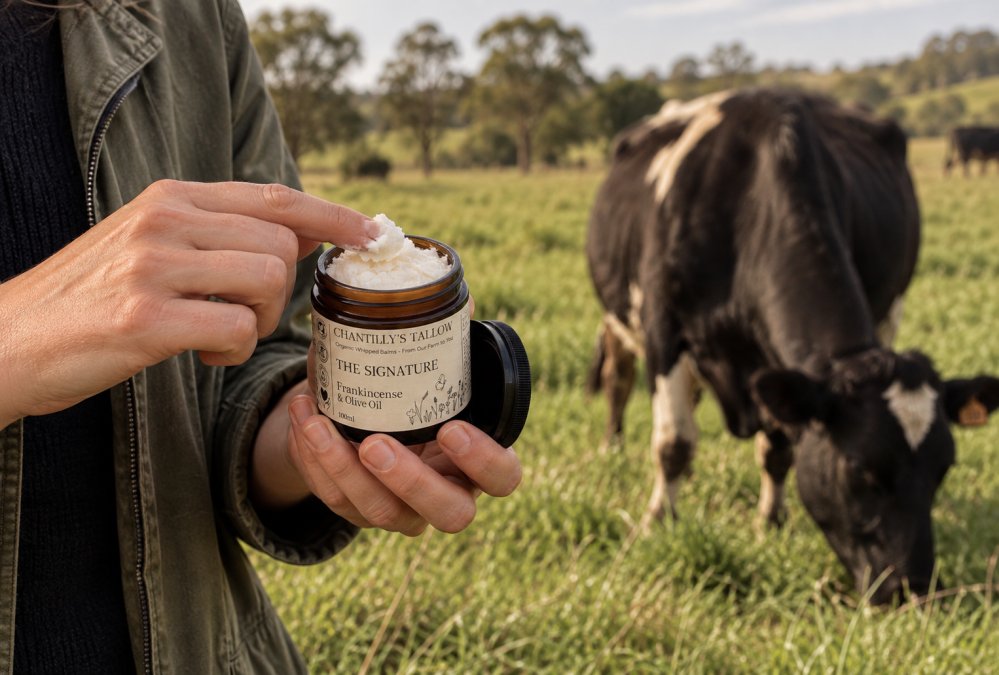
Here's where the conversation gets more interesting than a simple no. Tallow is a byproduct of the meat industry. It is not the reason a cow is raised, but it is a product of that system, and vegans avoid byproducts for the same reason they avoid the primary cuts.
Some tallow brands lean hard on the "nose-to-tail, nothing wasted" argument. It is a real sustainability point. It is also not a vegan argument, and conflating the two is where a lot of skincare marketing gets slippery. Waste reduction and animal-free are different claims.
The Fatty Acid Profile of Grass Fed Tallow
The fatty acid profile of grass fed tallow is roughly half saturated fat, with the rest split between monounsaturated and a small amount of polyunsaturated fat. The dominant fatty acids are oleic acid, palmitic acid, and stearic acid, with smaller amounts of myristic and linoleic acid.
That composition is why tallow behaves the way it does. Stearic and palmitic acids give it structure and a firm melting point, which sits close to body temperature. Oleic acid, the same monounsaturated fat found in olive oil, contributes emollient qualities that help soften skin. The triglycerides formed from these fatty acids are what give tallow its occlusive, barrier-supporting feel.
Grass-fed fat tends to carry a significantly better ratio of omega-3 to omega-6 fatty acids, with less inflammatory effects than grain-fed fat. The bigger practical point for skincare is the saturated fat backbone, which is what makes tallow a genuinely effective emollient.
Hidden Tallow in Processed Foods
Tallow hides in more packaged food than most people realise, and it rarely announces itself as "beef tallow." The most common disguise is "animal fat" or "rendered animal fat" on an ingredient panel. In some products it appears as "beef fat," "suet," or the broader term "tallow" without the word beef attached.
Where does it turn up? Fried snacks, some brands of chips, certain pastries and pie crusts, instant noodles, and traditional products like pemmican. Mutton fat is a close cousin and appears in similar categories. If you are avoiding animal products, these are the labels worth slowing down for.
Label Term | What It Usually Means | Vegan? |
|---|---|---|
Beef tallow | Rendered cattle fat | No |
Animal fat | Often beef or pork fat | No |
Rendered animal fat | Any rendered animal fat | No |
Suet | Raw beef or mutton fat | No |
Vegetable shortening | Plant oils, usually palm or soy | Usually yes |
Mutton fat | Rendered sheep fat | No |
Vegan Tallow Alternatives: Plant-Based Fats and Synthetic Options
There is no true plant equivalent to tallow, because no single plant fat replicates its exact fatty acid ratio. What exists instead are plant-based alternatives that mimic its texture and function, and a newer category of synthetic "vegan tallow" built in a lab. The two are not the same thing, and the difference matters if you are choosing based on processing rather than origin alone.
For skincare, the closest plant matches are:
- Shea butter for rich, occlusive barrier support
- Cocoa butter for a firm texture and melting point close to tallow's
- Mango butter for a lighter feel with similar emollient properties
- Jojoba oil for a wax ester that closely resembles human sebum
- Macadamia oil for deep hydration and fast absorption
- Olive oil for oleic acid content that mirrors tallow's monounsaturated profile
Cold-pressed oils retain more of their natural lipids and antioxidants than refined versions, which matters if you are choosing a plant fat for a beauty routine. For cooking, coconut oil, rice bran oil, and ghee alternatives cover most of what tallow does in a pan.
How Vegan Tallow Is Made
The synthetic version is where things get chemically interesting, and where most guides stop short. "Vegan tallow" is not a single ingredient, it is a category of engineered fats, and the route used to make them determines how processed the finished product really is.
Fractionation and recombination. The most common method starts with palm, coconut, or shea oil. The oil is fractionated, split into its separate fatty acid fractions, usually by controlled heating and cooling so different triglycerides crystallise out at different temperatures. Those fractions are then recombined in ratios designed to hit a target melting point and firmness. The result behaves like tallow in a pan or a jar, but it has been taken apart and rebuilt.
Hydrogenation and interesterification. To get a firmer, more shelf-stable fat, manufacturers may hydrogenate the oil, which adds hydrogen across double bonds and raises the melting point. Full hydrogenation creates saturated fat; partial hydrogenation can create trans fats, which is why most food-grade producers now avoid it. Interesterification is the alternative, it rearranges fatty acids on the triglyceride backbone without creating trans fats, using a catalyst. It is a chemical rearrangement, not a simple pressing.
Fermentation-derived fats. A newer route uses yeast or other microbes engineered to produce fats through fermentation, fed on plant sugars. The output is chemically identical to a target fat, including tallow-like triglycerides, without an animal. This is genuinely different from fractionated plant oil, it is a biotech product, not a blended one. It is also the most industrial route on this list, and the one most often marketed as simply "plant-based."
Enzymatic restructuring. Some producers use immobilised enzymes (lipases) to swap fatty acids between triglycerides under mild conditions, avoiding the harsher chemicals of interesterification. It is cleaner on paper, but it is still a lab process, not a kitchen one.
The trade-off is processing. A cold-pressed shea butter is a simple product, press, filter, jar. A synthetic tallow that has been fractionated, hydrogenated or interesterified, and reformulated is a much more industrial one. If your reason for going vegan is environmental, or about avoiding highly processed ingredients, that distinction is worth weighing. "Vegan" tells you what is absent. It does not tell you what was done to the oil before it reached the jar.
How to Spot Tallow on Ingredient Labels
Scan the ingredient list before the front of the pack. Tallow and its relatives appear under a handful of names, and once you know them, spotting them takes seconds. The harder problem is the second layer, the additives and processing aids that carry animal fat without ever using the word.
Start with the direct names:
- Check for "beef tallow," "tallow," or "beef fat"
- Look for "animal fat" or "rendered animal fat"
- Watch for "suet" and "mutton fat"
- Check the first five ingredients, where major components sit
- Look for a recognised vegan certification logo, not just the word "vegan"
- Be wary of "plant-based" on a product that also lists animal fat
The E-Number and Additive Layer
Animal fats hide in additive codes and technical names that most shoppers never connect to a cow or a sheep. These are the ones worth memorising:
Additive or term | What it is | Why it matters |
|---|---|---|
E430, E431, E432, E433, E434, E435, E436 | Polysorbates (including polysorbate 80) | Emulsifiers that may be derived from animal fats, though plant sources are common, the label rarely specifies |
E470, E471, E472 | Mono- and diglycerides of fatty acids | Emulsifiers that can be animal- or plant-derived; E471 is extremely common in baked goods |
E481, E482 | Sodium and calcium stearoyl lactylate | Dough conditioners that can be made from animal stearic acid |
E542 | Bone phosphate | Derived from animal bone; used as an anti-caking agent |
E901 | Beeswax | Animal-derived (insect), not vegan |
E920 | L-cysteine | Dough conditioner often derived from animal hair or feathers, though synthetic and microbial versions exist |
"Lard," "dripping," "schmaltz" | Pig, beef, or chicken fat | Direct animal fats under regional names |
"Gelatine," "gelatin" | Animal collagen | Not tallow, but the same byproduct logic |
"Natural flavouring" | Unspecified | Can carry animal-derived carriers or extracts; not required to be broken down |
"Mono- and diglycerides" (spelled out) | Same as E471 | Frequently animal-derived in cheaper products |
A single additive is not proof. E471, for example, is often made from palm or soy. The point is that the label does not tell you which, and if you are avoiding animal byproducts strictly, an unspecified emulsifier is a question mark, not a green light.
Where It Turns Up
Beyond the obvious fried snacks, chips, pastries, pie crusts, instant noodles, and traditional products like pemmican, tallow and its cousins appear in:
- Baked goods, biscuits, crackers, and some breads use E471 or animal shortening for texture
- Confectionery, some chewy sweets and chocolate coatings use gelatine or animal-derived emulsifiers
- Gravies, stocks, and instant sauces, "animal fat" is a common base
- Roast potatoes and oven chips, beef dripping is a traditional frying fat in some brands
- Soap and cosmetics, sodium tallowate is the saponified form of tallow and appears in many commercial bar soaps
- Candles and crayons, tallow and stearic acid (often animal-derived) are common
Mutton fat is a close cousin and appears in similar categories. If you are avoiding animal products, these are the labels worth slowing down for.
Vegan certification matters here. A registered trademark logo from an accredited certifier means an independent body has audited the supply chain, including additive sourcing. A brand simply typing "vegan" on a label means nothing legally, and it is one of the easiest claims to make without proof.
Frequently Asked Questions
Is there a vegan alternative to beef tallow?
Yes. Vegan tallow alternatives include plant butters like shea and cocoa, cold-pressed oils such as olive and jojoba, and synthetic options like candelilla wax. Each has a different melting point and texture, so they suit different uses. For skincare, shea butter and macadamia oil offer deep hydration without animal products. For cooking, coconut oil or olive oil work well. Always check the label for vegan certification to be sure.
Can vegans use tallow-based skincare products?
No. Tallow comes from rendered animal fat, so any product containing it is not vegan. Even if the tallow is a byproduct of the meat industry, it still involves animal exploitation. Vegans who want similar skin-loving benefits can look for plant-derived emollients like shea butter, jojoba oil, or macadamia oil. These provide barrier support and deep hydration without using animal ingredients.
Why is beef tallow considered an animal-derived product?
Beef tallow is rendered from the fat of cattle, usually around the kidneys and loins. It is an animal byproduct of the meat industry. Because it comes directly from an animal, it is not vegan. The fatty acid profile of grass fed tallow is rich in saturated fats and triglycerides, but that does not change its origin. Any product made with tallow, whether food or cosmetic, is non-vegan.
How can I tell if a product contains tallow?
Check the ingredient list for terms like tallow, beef fat, rendered animal fat, or mutton fat. In cosmetics, it may appear as sodium tallowate or tallow acid. In foods, it can be listed as beef fat or animal shortening. If you are unsure, look for vegan certification logos. When in doubt, contact the manufacturer directly and ask about the source of any ambiguous ingredients.