 ultimate-guide
Beef Tallow for Psoriasis: Benefits & How to Use
Table of Contents
- What Is Beef Tallow and Why It Matters for Psoriasis
- How Beef Tallow for Psoriasis May Ease Symptoms
- Tallow Balm Ingredients for Skin Repair
- How to Use Tallow Balm for Psoriasis
- Tallow Balm Shelf Life and Storage
- Is Beef Tallow Safe for Sensitive Skin and Long-Term Use?
- Frequently Asked Questions
Last Updated: September 12, 2026
What Is Beef Tallow and Why It Matters for Psoriasis
Beef tallow is rendered fat from cattle, and it has become one of the most talked-about ingredients in natural skincare. This guide from Chantilly's Tallow looks at what beef tallow for psoriasis treatment can realistically do, and where it fits alongside the care your doctor prescribes.
Psoriasis is a chronic inflammatory condition that speeds up the skin's renewal cycle, producing thickened plaques, scaling and itching. Because the outer layer of skin is compromised, moisture escapes and irritants get in more easily. A rich, fat-based balm can help slow that water loss while the underlying inflammation is managed medically.
The fatty acid profile: stearic, oleic, linoleic and palmitic acids
Tallow's behaviour on skin comes down to its fatty acid composition. Stearic acid and palmitic acid are saturated fats that give tallow its firm, occlusive quality, forming a breathable layer that limits water loss. Oleic acid is a monounsaturated fat that softens and helps other ingredients absorb. Linoleic acid, a polyunsaturated fat, supports the skin barrier and is often low in people with inflammatory skin conditions.
That mix matters for psoriasis. Occlusive fats reduce scaling and transepidermal water loss, while emollient fats keep the plaque surface flexible so it cracks less. The lipid profile of grass-fed tallow sits reasonably close to the fats found naturally in human skin, which is why many people find it comfortable rather than greasy.
How tallow compares with synthetic moisturisers
Feature | Beef tallow balm | Synthetic moisturiser |
|---|---|---|
Main ingredients | Rendered animal fat, plant oils | Water, petrolatum, silicones, preservatives |
Occlusive effect | Strong, breathable film | Varies; often petrolatum-based |
Added fragrance | Usually none | Often present |
Preservatives needed | Typically none in anhydrous balms | Required |
Best for | Very dry, scaly, reactive skin | Light daily hydration |
Water-based creams hydrate quickly but need preservatives and often fragrance, both of which can sting compromised skin. An anhydrous tallow balm skips water entirely, so it is less likely to trigger sensitivity. It will not replace a prescribed treatment, but it can sit alongside one comfortably.
How Beef Tallow for Psoriasis May Ease Symptoms
Tallow helps mainly by restoring the skin barrier, not by suppressing inflammation. That distinction matters, because psoriasis is driven by immune activity that a moisturiser cannot switch off. What a good balm can do is reduce the mechanical irritation that makes plaques worse.
Reducing scaling and supporting skin barrier function
Scaling happens when the skin loses water faster than it can hold it. An occlusive balm slows that loss, which softens plaques and reduces the flaking that sheds onto clothing and bedding. Less scaling also means less cracking, and cracked plaques are both painful and a route for infection.
Supporting barrier function has a knock-on effect on itching, or pruritus. Dry, tight skin itches more. When the barrier is better hydrated, the urge to scratch drops, and scratching is one of the biggest triggers for a psoriasis flare-up.
What the clinical evidence does and doesn't show
Here is where honesty matters. There is no large body of clinical evidence proving beef tallow treats psoriasis. Most support is anecdotal, from people who found it soothing where other moisturisers failed. That is not the same as proof.
What the evidence does support is that consistent, occlusive moisturising helps psoriasis by reducing dryness, scaling and irritation. Tallow is one way to deliver that. It is not a substitute for prescribed treatment, and anyone with moderate to severe psoriasis should treat it as a supporting step, not a cure. Listen to your skin. Trying tallow on a particular area against another will give you a true sense of the effects it is or isnt providing.
Tallow Balm Ingredients for Skin Repair
A tallow balm is only as good as what goes into it. Plain rendered tallow works, but most quality balms pair it with plant oils that add linoleic acid, vitamin E and a lighter feel on the skin.
Complementary oils do different jobs:
- Olive oil is rich in oleic acid and antioxidants, and it adds slip so the balm spreads without dragging on sore plaques.
- Jojoba oil is technically a liquid wax and closely resembles human sebum, so it absorbs without leaving a heavy residue.
- Macadamia oil is high in palmitoleic acid, which is well tolerated by reactive skin and helps the balm stay soft at room temperature.
Sourcing matters just as much as the oil list. Tallow from grass-fed, organically raised cattle tends to carry a better nutrient profile, and how the fat is rendered affects the final texture and smell. Look for small-batch producers who can tell you where the cattle came from and how the fat was processed. Chantilly's Tallow, for example, renders its tallow from its own grass-fed herd on a Gippsland farm, which is the kind of traceability worth asking any supplier about.
How to Use Tallow Balm for Psoriasis
Using tallow balm well comes down to timing, quantity and a proper patch test. Get those three right and most people see a difference in comfort within a couple of weeks.
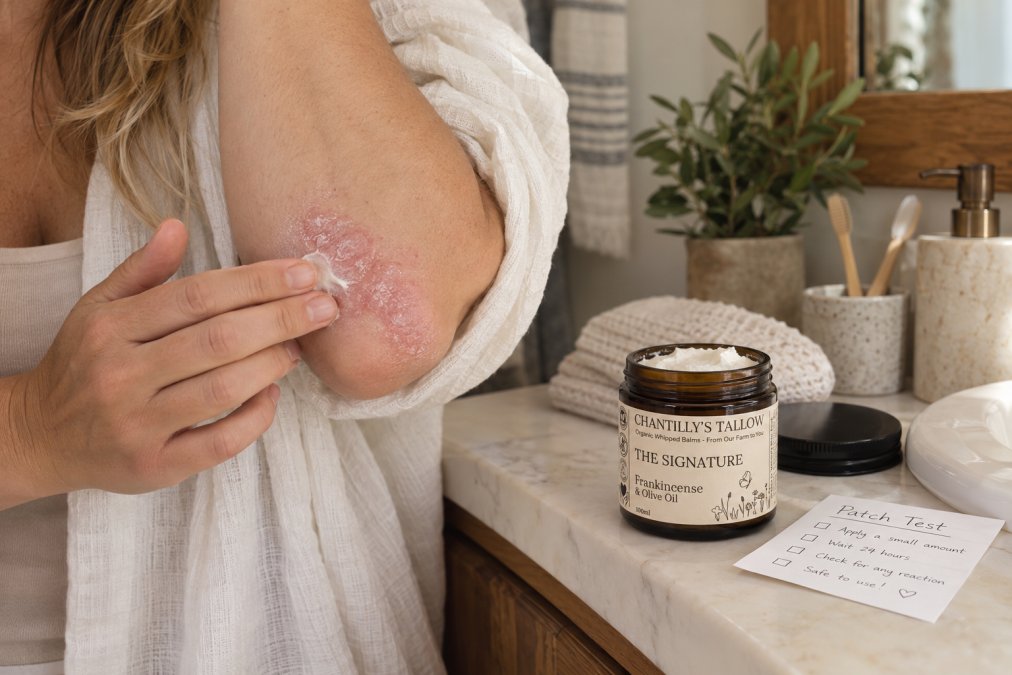
- Patch test first. Apply a pea-sized amount to the inner forearm and wait 24 to 48 hours. Check for redness, itching or swelling before using it anywhere else.
- Start on clean, slightly damp skin. Pat the area dry after a lukewarm shower, leaving a little moisture behind, then apply.
- Use a small amount. Warm a pea-sized quantity between your fingers and press it into the plaque rather than rubbing hard.
- Apply twice daily. Morning and evening works for most people. Consistency matters more than quantity.
- Layer with prescribed treatments. Apply medication first if your doctor has specified a wait time, then balm over the top to seal it in.
- Reapply after washing. Water strips the film, so top up after showers or hand washing.
Patch testing and integration with prescribed treatments
Patch testing is the step most people skip, and it is the one that prevents a bad reaction on a large area of skin. Even natural ingredients can irritate, and psoriasis plaques are already compromised.
Integration is straightforward once you know the order. If your dermatologist has prescribed a topical, apply that first and let it absorb for the time they recommend, then follow with balm. Never swap a prescription for a balm without talking to your doctor, and bring the balm to your next appointment so they can check the ingredients.
Tallow Balm Shelf Life and Storage
Anhydrous tallow balm has no water content, so it resists spoilage far better than a cream. Stored correctly, most balms keep for 12 to 24 months from the date of manufacture, though the exact figure depends on the oils blended in and whether any vitamin E was added as a stabiliser. Check the label on your jar for the maker's stated shelf life.
Storage conditions matter more than most people realise:
- Keep the jar below 28°C, away from direct sun and heat sources like stovetops or radiators.
- Store it in a cool, dark cupboard rather than a steamy bathroom shelf.
- Keep the lid sealed to stop oxygen and moisture getting in.
- Use clean, dry fingers or a small spatula to avoid introducing bacteria.
- If the balm smells rancid, looks discoloured or feels gritty, throw it out.
In warmer months, tallow balm can soften or partially melt. That does not ruin it. Let it firm up again in a cool spot and stir it back together if the oils have separated.
Is Beef Tallow Safe for Sensitive Skin and Long-Term Use?
For most people, tallow is well tolerated, and its short ingredient list makes it a reasonable option for reactive skin. It is non-comedogenic for many users, free of the synthetic fragrances that trigger reactions, and gentle enough for daily use on adults and children alike.
A few caveats are worth knowing. Anyone with a known allergy to beef or dairy proteins should patch test carefully or avoid tallow altogether. If you are prone to fungal acne or have very oily, acne-prone skin, a heavy occlusive balm may feel too rich in some areas. Start on an isolated area and watch for the changes before applying to the whole area if you are concerned. Less is also more with tallow; a whipped balm is lighter and gives more spread ability. Start with a small amount and add more if you skin needs more, rather than starting with a thicker layer at first you will soon figure out how much feels right for skin and when depending on the seasons.
A proper patch test protocol
Patch testing is the step most people skip, and it is the one that prevents a bad reaction across a large area of compromised skin. A pea-sized dab on the forearm is not enough on its own. A more reliable protocol:
- Choose the site. Inner forearm, away from any active plaque.
- Apply a small amount. About the size of a grain of rice, rubbed in gently.
- Wait 24 hours. Check for redness, itching, swelling or a burning sensation.
- Repeat on a second site. If clear, apply to a small patch of unaffected skin near, but not on, a plaque.
- Wait another 24 to 48 hours. If still clear, begin use on plaques.
- Stop immediately if you develop spreading redness, blistering, or swelling beyond the test site, and seek medical advice.
Psoriasis plaques are already compromised, so a reaction there can look worse and last longer than the same reaction on healthy skin. Test on intact skin first, every time you open a new jar or try a new formulation.
Integrating tallow with prescribed treatments
This is the part most guides leave out, and it is the part that matters most if you are on active treatment.
- Topical steroids and vitamin D analogues. Apply the prescription first, wait the interval your prescriber specified (often 10 to 30 minutes), then apply balm over the top. Do not mix them in your hand, and do not apply balm first, as the occlusive film can increase absorption of the steroid beyond what was intended.
- Biologics and systemics. A topical balm does not interact with these, but tell your dermatologist what you are using so it is on the record. Bring the jar to your appointment.
- Coal tar, salicylic acid and other keratolytics. These can be drying. A balm applied afterwards is often helpful, but check the order with your prescriber, as some products are designed to be left uncovered.
- Never swap a prescription for a balm. If cost, side effects or convenience are the reason you want to stop, raise that with your prescriber. There is usually a better option than stopping cold.
Long-term use and what to watch for
There is no evidence that regular tallow use harms the skin. The bigger risk is relying on it alone for a condition that needs medical management. Used as a barrier-supporting balm alongside proper treatment, it is a low-risk addition for most people.
Watch for these signals over months of use:
- New or spreading plaques despite consistent use, which suggests the medical plan needs review.
- Signs of infection such as weeping, crusting, warmth or increasing pain, which need prompt medical attention.
- Folliculitis or small bumps in hair-bearing areas, which can happen with any heavy occlusive.
- Rancid smell or gritty texture in the jar, which means it is time to replace it.
Storage and shelf life
Anhydrous tallow balm has no water content, so it resists spoilage far better than a cream. Stored correctly, most balms keep for 12 to 24 months from the date of manufacture, though the exact figure depends on the oils blended in and whether any vitamin E was added as a stabiliser. Check the label on your jar for the maker's stated shelf life.
- Keep the jar below 28°C, away from direct sun and heat sources like stovetops or radiators.
- Store it in a cool, dark cupboard rather than a steamy bathroom shelf.
- Keep the lid sealed to stop oxygen and moisture getting in.
- Use clean, dry fingers or a small spatula to avoid introducing bacteria.
- If the balm smells rancid, looks discoloured or feels gritty, throw it out.
In warmer months, tallow balm can soften or partially melt. That does not ruin it. Let it firm up again in a cool spot and stir it back together if the oils have separated.
Frequently Asked Questions
Is beef tallow effective for managing psoriasis symptoms?
Beef tallow is an emollient and occlusive moisturiser, meaning it can help reduce transepidermal water loss and support skin barrier function. Some people with psoriasis find it soothes scaling and pruritus. However, it is not a cure and clinical evidence specific to psoriasis is limited. It works best as a complementary moisturiser alongside prescribed treatments, not as a replacement.
Can tallow be used alongside prescribed topical treatments?
Yes, many people layer tallow balm over or under prescribed topicals, but timing matters. Apply prescribed treatments first and wait as directed before applying tallow, or ask your doctor or pharmacist about sequencing. Always patch test on a small area first. If you notice increased erythema, irritation or flare-ups, stop use and speak to your healthcare provider.
Are there any risks to using animal-based fats on inflammatory skin conditions?
Animal-based fats like beef tallow are generally well tolerated, but risks include allergic reaction, clogged pores in acne-prone areas, and irritation if the product contains added fragrances or preservatives. People with sensitive skin should patch test for 24 to 48 hours. If you have a known allergy to beef or dairy, avoid tallow and consult your doctor.
How should tallow balm be stored to maintain its integrity?
Store tallow balm in a cool, dark place below 28°C, away from direct sunlight and heat. If your home runs warm, the fridge is fine; it will firm up but remain usable. Keep the lid sealed to prevent contamination, and use clean, dry hands or a small spatula to scoop. Properly stored, tallow balm typically keeps for 12 to 18 months.