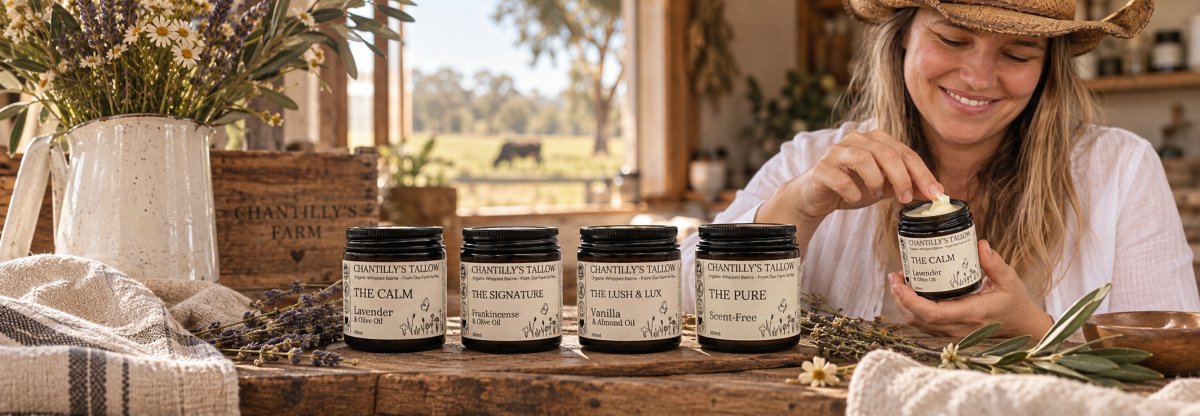
 comparison
Tallow Alternatives for Sensitive Skin: 2026 Guide
Table of Contents
- Why Sensitive Skin Needs Specialised Alternatives
- Tallow vs Jojoba Oil for Face: Which Suits Your Skin
- Nutrient Profiles: What Sensitive Skin Actually Needs
- Grass-Fed Tallow: Benefits for Eczema and Reactive Skin
- How to Store Tallow Balm and Maximise Shelf Life
- Patch Testing and Safety Protocols Before Full Application
- Frequently Asked Questions
Last Updated: September 1, 2026
Why Sensitive Skin Needs Specialised Alternatives
Sensitive skin reacts to most things. If you've managed eczema, psoriasis, or reactive dermatitis, you know the frustration of finding a moisturiser that calms inflammation without triggering fresh flares.
Conventional skincare is built for average skin. Thick emulsifiers, synthetic fragrances, and preservatives become irritants for those with compromised barriers. Many people cycle through products for years, each promising relief but delivering disappointment.
What makes an alternative genuinely suitable for sensitive skin isn't just what it contains, but what it doesn't contain, and how closely its molecular structure mirrors your skin's own chemistry. The most effective solutions work with your skin's biology rather than against it. The right alternative can do more than soothe; it can actively repair the barrier function compromised by years of inflammation or harsh treatments.
The products examined here share a common principle: they respect your skin microbiome and avoid the inflammatory triggers that dermatologists increasingly recognise as problematic for sensitive skin conditions.
Tallow vs Jojoba Oil for Face: Which Suits Your Skin
Tallow and jojoba oil approach facial hydration from opposite directions, each with distinct advantages for sensitive skin.
Tallow is rendered fat from grass-fed cattle that structurally mimics human sebum. Your skin recognises it immediately and absorbs it efficiently, creating a protective occlusive barrier that locks in moisture. Jojoba oil is a plant-derived wax ester that penetrates deeper into dermal layers without leaving a heavy surface film.
For reactive skin, the choice depends on what your barrier needs most. If your skin is severely compromised, cracked, weeping, or intensely inflamed, tallow's occlusive properties create an immediate protective seal. Jojoba works better if your barrier is intact but deeper layers are dehydrated; it delivers hydration without the heavy feel that some find suffocating on sensitive skin.
The nutrient profiles differ too. Tallow delivers fat-soluble vitamins A, D, E, and K in forms your skin can use directly. Jojoba contains linoleic and oleic acids, essential fatty acids that support barrier function but require your skin to process them. For severe eczema or psoriasis, tallow's direct nutrient delivery can support visible improvement. For milder sensitivity or those preferring a lighter texture, jojoba feels more comfortable.
One practical consideration: some people find that some tallow has a subtle beef note that often fades after application. Tallow production methods effect the odour, and quality producers are often able to produce odourless nutrient dense balms. Jojoba is completely unscented and blends seamlessly into any routine. If you're sensitive to smell, jojoba might feel like the safer starting point, even if tallow ultimately delivers better results. When looking for brands, look for reviews where no beefy smell is mentioned.
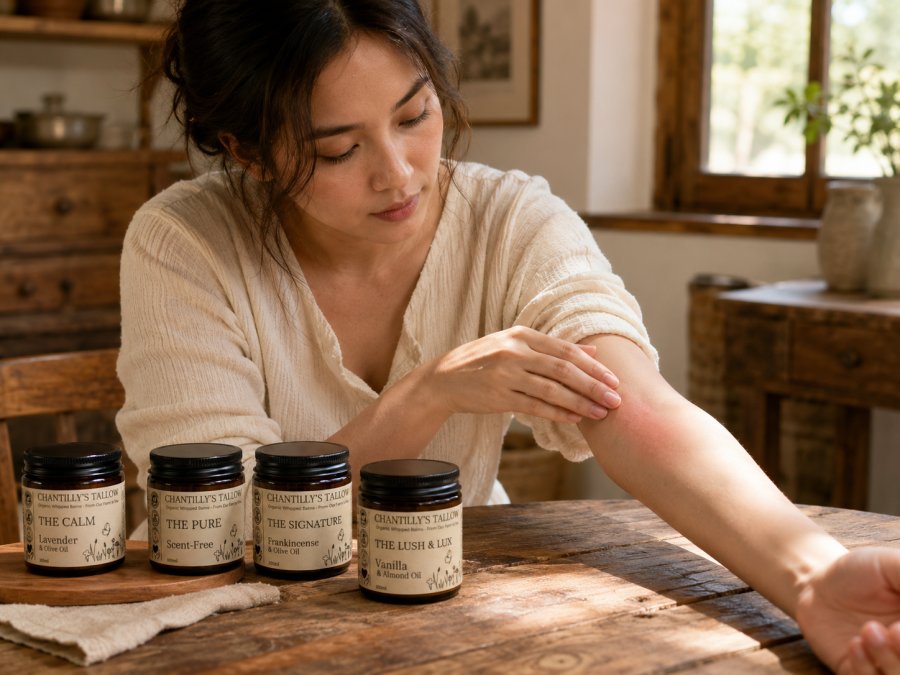
Nutrient Profiles: What Sensitive Skin Actually Needs
Sensitive skin isn't just dry skin; it's skin that's lost the ability to regulate inflammation and maintain its protective barrier. This means the nutrients it needs are specific and non-negotiable.
Vitamin A supports skin cell turnover and strengthens the barrier in forms your skin can use without irritation. Tallow delivers vitamin A in its retinyl form, which your skin converts gently without the inflammatory response synthetic retinoids trigger.
Vitamin D regulates immune function in your skin and reduces inflammatory markers associated with eczema and psoriasis. Most people with chronic skin conditions are deficient in vitamin D.
Vitamin E is a direct antioxidant that protects against oxidative stress, a major driver of inflammation in reactive skin. It also stabilises other nutrients, preventing rancidity that would trigger irritation.
Vitamin K reduces inflammation and supports vascular health in the skin, which is why it appears in many eczema-focused formulations.
Omega fatty acids (3, 7, 9) are structural components of your skin's lipid barrier. When your barrier is compromised, these fats are depleted. 100% Grass-fed tallow is exceptionally rich in omega-7 and omega-9; plant oils typically deliver omega-3 and omega-6 more effectively.
CLA (conjugated linoleic acid) appears primarily in grass-fed animal fats and has anti-inflammatory properties specific to skin. It's not found in significant amounts in plant-based alternatives, which is a genuine advantage for tallow-based products when managing inflammatory skin conditions.
The difference between a product that merely moisturises and one that actually repairs comes down to whether these nutrients are present in bioavailable forms. Chantilly's Tallow products deliver all of these in concentrations and forms your compromised barrier can actually use, which can support measurable improvement with consistent use.
Grass-Fed Tallow: Benefits for Eczema and Reactive Skin
100% Grass-fed tallow has become increasingly popular for managing chronic skin conditions. When cattle are grass-fed rather than grain-fed, their fat composition changes fundamentally. Grass-fed tallow contains higher concentrations of omega-7 and CLA, lower inflammatory markers, and a fatty acid profile that more closely mirrors human sebum. Your skin doesn't treat it as a foreign substance to be processed and expelled; instead, it integrates into your barrier as if it were your own natural oil.
For eczema, the benefits show up in two ways. First, the occlusive barrier prevents the constant water loss that drives eczema cycles. Second, the nutrient density, particularly vitamin A and anti-inflammatory fatty acids, actively reduces the inflammatory cascade that causes itching and flaking. Many people report that the itching cycle can break within days of starting tallow.
Psoriasis responds differently. Rather than just sealing the barrier, tallow can help modulate the immune overreaction that characterises psoriasis. The CLA and specific fatty acid ratios appear to calm the inflammatory signalling that drives excessive skin cell turnover. Results can take longer, but people often report more durable improvement than with other moisturisers.
Reactive dermatitis benefits from both mechanisms: immediate barrier protection and longer-term immune modulation. Because tallow is hypoallergenic and free from common irritants that trigger reactive skin, it rarely provokes fresh flares even in people with severe sensitivities.
The unscented formulations matter here. Many people with eczema or psoriasis are also sensitive to fragrance, both synthetic and essential oils. Chantilly's Tallow's Scent-Free & Olive Tallow Balm removes this variable entirely, combining grass-fed tallow with organic olive oil for enhanced spread ability without adding irritants.
How to Store Tallow Balm and Maximise Shelf Life
Tallow balm shelf life depends entirely on storage conditions. Done correctly, a jar lasts 12-18 months. Done poorly, it can go rancid in weeks.
The core issue is oxidation. Tallow contains unsaturated fats that break down when exposed to heat, light, or oxygen. Rancid tallow loses its therapeutic properties and can actually irritate sensitive skin.
Temperature is the primary factor. Store tallow balm in a cool, dark place, ideally below 28°C. A bathroom cabinet away from the shower is better than a shelf above the sink where steam and heat accelerate oxidation. Never leave tallow in direct sunlight or near heat sources. If your home is particularly warm, refrigerator storage extends shelf life significantly, though it makes the balm firmer.
Containers matter. Glass jars with tight-sealing lids are ideal. Opaque glass (amber or violet) is better than clear because it blocks light. Always ensure the lid seals completely after each use.
Moisture is the secondary concern. Water exposure triggers microbial growth and accelerates rancidity. Never dip wet fingers into the jar. Use a clean, dry applicator every time. If water gets into the jar, shelf life drops dramatically.
Signs of rancidity: A sharp, unpleasant smell (distinctly different from tallow's subtle beef note), visible discolouration, or a grainy texture indicate oxidation has begun. Discard the product rather than risk irritating sensitive skin.
Under optimal conditions, cool storage, sealed container, clean application, a 100ml jar of Chantilly's Tallow typically remains stable for 12-18 months. Once opened and in regular use, plan on using it within 6-9 months for best results.
Tallow Balm Shelf Life: Timeline and Oxidation Risks
Unopened jar: 18-24 months in cool, dark storage.
Opened jar, ideal storage (20-28°C, sealed, dark): 12-18 months.
Opened jar, average storage (room temperature, occasional light exposure): 6-9 months.
Opened jar, poor storage (warm bathroom, repeated moisture exposure): 2-4 months.
Refrigerated storage: Extends all timelines by 30-50% because cold dramatically slows oxidation.
The oxidation process is gradual. You might notice the smell shifting subtly before the balm becomes fully rancid. This is your signal to use it up or switch to a fresh jar. With sensitive skin, using partially oxidised tallow is worse than using nothing.
Patch Testing and Safety Protocols Before Full Application
Even products designed for sensitive skin can trigger reactions in specific individuals. Patch testing is the only way to know whether a product will work for your skin before committing to full-face application.
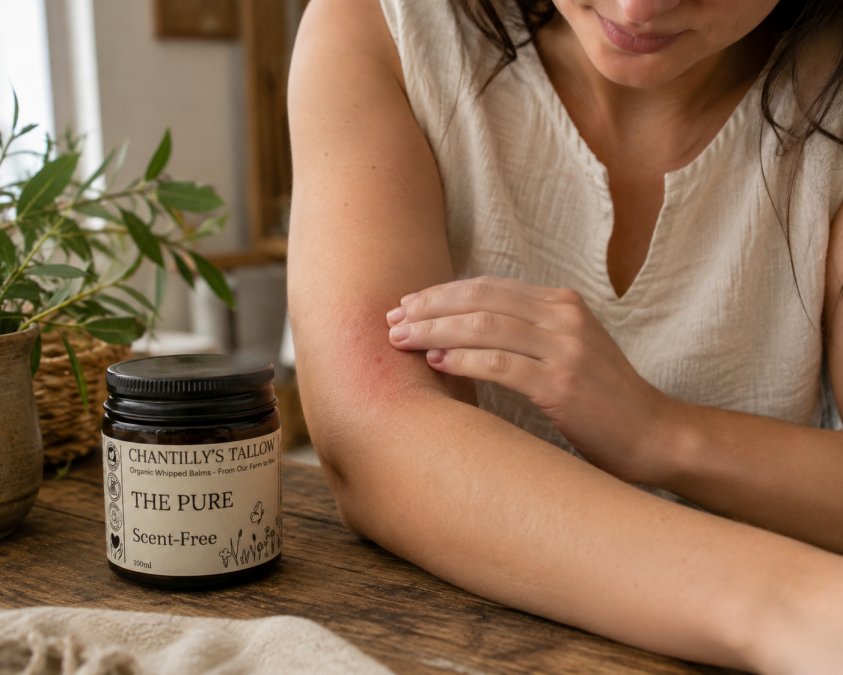
The 48-hour patch test is the standard protocol. Choose a small, inconspicuous area, the inner arm, behind the ear, or inside the elbow are ideal because the skin there is thin and reactive. Clean the area gently and allow it to dry completely.
Apply a small amount of balm, roughly the size of a grain of rice, and rub it in gently. Don't wash it off. Leave it undisturbed for 48 hours. Monitor for redness, itching, swelling, warmth, or any other reaction. Many reactions develop within the first 6-12 hours, but some take the full 48 hours to emerge.
Why 48 hours? Delayed hypersensitivity reactions (the most common type in people with eczema) often don't appear immediately. The 48-hour window captures both immediate and delayed responses.
If the patch test shows no reaction after 48 hours, proceed cautiously to broader application. Start with a small area of your face, perhaps just one cheek, and use the balm for 3-5 days before expanding to your full routine.
What counts as a reaction? Redness, itching, burning, swelling, hives, or any sensation of irritation means the product isn't suitable for you. Some people experience a temporary "adjustment period" where their skin feels slightly warm or tingly; this is usually normal as your barrier adjusts to a new nutrient-dense product. True reactions are unambiguous and clearly abnormal for your skin.
For people with severe sensitivities, consider an even more conservative approach: test on a 1cm square behind your ear for the full 48 hours, then wait another 48 hours before testing on a larger area.
Document your results. Keep a simple note of when you tested, where you tested, and any reactions. If you're trialling multiple products, this record prevents confusion about which product caused which reaction.
If you're currently using topical steroids or other prescription treatments, discuss new skincare products with your dermatologist before introducing them.
Sensitive skin demands more from skincare than tolerance; it demands active repair. Whether you choose tallow, jojoba, or another alternative depends on your specific condition, your skin's current state, and what your barrier needs most right now. The common thread across all effective alternatives is that they work with your skin's biology rather than against it.
The most important step you can take is the patch test. It's the only way to know whether a product will genuinely help or trigger another painful cycle of inflammation and frustration. Once you've confirmed compatibility, consistent use of a nutrient-dense, barrier-supporting product like Chantilly's Tallow can transform how your skin feels and functions, not overnight, but measurably within weeks.
Australian Dermatological Society guidance on sensitive skin management
Your skin has spent years in a reactive state. Give it the right support, and it can heal. Find Your Balm
Frequently Asked Questions
What makes grass-fed tallow a better alternative for sensitive skin than synthetic moisturisers?
Grass-fed tallow is bio-compatible with human skin because its fatty acid profile closely mirrors the skin's natural sebum. This similarity allows deeper penetration and absorption without triggering inflammation. Unlike synthetic moisturisers that sit on the surface, tallow supports barrier repair and reduces transepidermal water loss. For sensitive skin, this means less irritation and stronger long-term healing, particularly for conditions like eczema and psoriasis where the skin barrier is compromised.
How does tallow compare to jojoba oil for face care on reactive skin?
Tallow and jojoba oil serve different purposes. Jojoba oil penetrates quickly and closely resembles sebum, making it ideal for very oily or acne-prone sensitive skin. Tallow is richer and more occlusive, creating a protective barrier that locks in moisture—better for dry, inflamed, or eczema-prone skin. Jojoba works as an emollient; tallow functions as both emollient and occlusive. For reactive skin, the choice depends on whether you need deep hydration (tallow) or lighter, faster absorption (jojoba). Many people find tallow more effective for barrier repair.
What should I do if I'm concerned about tallow causing breakouts or irritation?
Perform a patch test before full application. Apply a small amount (rice-grain size) to clean skin behind your ear or on your inner arm, and wait 24–48 hours. Monitor for redness, itching, or swelling. If no reaction occurs, gradually introduce the product to a larger area of the face over a week. Start with two to three applications per week. Keep a simple routine during this period—avoid introducing other new products simultaneously. If irritation develops, discontinue use and consult a dermatologist. High-quality, unscented formulations minimise the risk of adverse reactions.
How long does tallow balm last, and what storage conditions keep it stable?
Properly stored tallow balm typically lasts 12–18 months. Store in a cool, dark place away from direct sunlight and heat (below 20°C is ideal). Use airtight, opaque containers to prevent oxidation and rancidity. Avoid storing in bathrooms where humidity and temperature fluctuate. Cold-pressed or rendered tallow is more stable than oxidised fat. Signs of degradation include off-odours, discolouration, or a grainy texture. If stored correctly in sealed glass or aluminium containers, quality grass-fed tallow resists spoilage far longer than plant-based oils.
Frequently Asked Questions
Q: What makes grass-fed tallow a better alternative for sensitive skin than synthetic moisturisers?
A: Grass-fed tallow is bio-compatible with human skin because its fatty acid profile closely mirrors the skin's natural sebum. This similarity allows deeper penetration and absorption without triggering inflammation. Unlike synthetic moisturisers that sit on the surface, tallow supports barrier repair and reduces transepidermal water loss. For sensitive skin, this means less irritation and stronger long-term healing, particularly for conditions like eczema and psoriasis where the skin barrier is compromised.
Q: How does tallow compare to jojoba oil for face care on reactive skin?
A: Tallow and jojoba oil serve different purposes. Jojoba oil penetrates quickly and closely resembles sebum, making it ideal for very oily or acne-prone sensitive skin. Tallow is richer and more occlusive, creating a protective barrier that locks in moisture—better for dry, inflamed, or eczema-prone skin. Jojoba works as an emollient; tallow functions as both emollient and occlusive. For reactive skin, the choice depends on whether you need deep hydration (tallow) or lighter, faster absorption (jojoba). Many people find tallow more effective for barrier repair.
Q: What should I do if I'm concerned about tallow causing breakouts or irritation?
A: Perform a patch test before full application. Apply a small amount (rice-grain size) to clean skin behind your ear or on your inner arm, and wait 24–48 hours. Monitor for redness, itching, or swelling. If no reaction occurs, gradually introduce the product to a larger area of the face over a week. Start with two to three applications per week. Keep a simple routine during this period—avoid introducing other new products simultaneously. If irritation develops, discontinue use and consult a dermatologist. High-quality, unscented formulations minimise the risk of adverse reactions.
Q: How long does tallow balm last, and what storage conditions keep it stable?
A: Properly stored tallow balm typically lasts 12–18 months. Store in a cool, dark place away from direct sunlight and heat (below 20°C is ideal). Use airtight, opaque containers to prevent oxidation and rancidity. Avoid storing in bathrooms where humidity and temperature fluctuate. Cold-pressed or rendered tallow is more stable than oxidised fat. Signs of degradation include off-odours, discolouration, or a grainy texture. If stored correctly in sealed glass or aluminium containers, quality grass-fed tallow resists spoilage far longer than plant-based oils.