 blog
Best Natural Moisturizer for 50s: 2026 Guide
Table of Contents
- What Happens to Skin in Your 50s
- Key Ingredients in the Best Natural Moisturizer for 50s
- Tallow Balm for Dry Skin: Why It Works After 50
- Application Techniques for Sagging Skin and Fine Lines
- How to Store Tallow Balm for Maximum Shelf Life
- Building a Natural Anti-Ageing Skincare Routine
- Choosing the Right Natural Moisturizer for Your Skin
- Frequently Asked Questions
Last Updated: September 14, 2026
What Happens to Skin in Your 50s
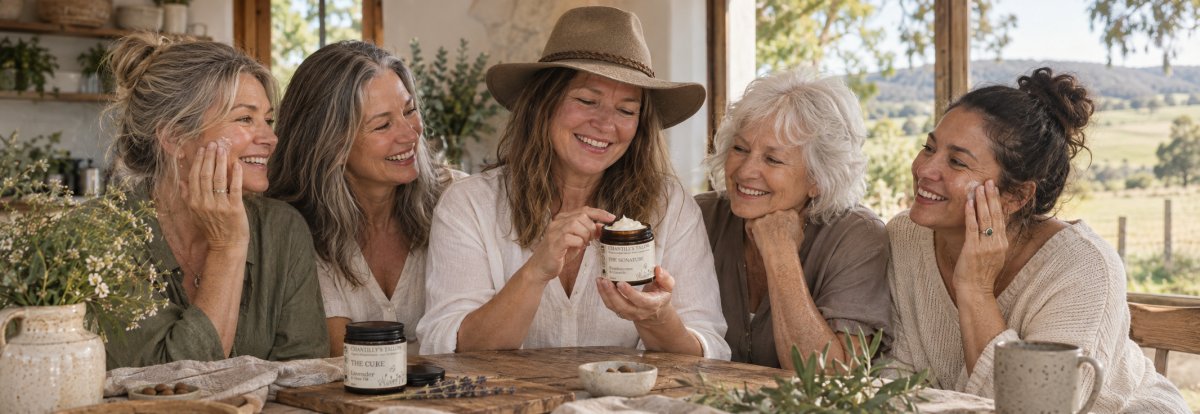
The best natural moisturizer for 50s skin has to do more than add water. It has to work with a barrier that is thinning, a lipid layer that is depleting, and collagen production that has slowed for years.
That is the core problem most guides skip past. Skin in your fifties is not just drier than it was at thirty. It is structurally different. The natural moisturizer that worked in your forties often stops pulling its weight, and people blame the product when the real shift is physiological.
Here is what is actually changing beneath the surface.
Hormonal Skin Changes and Collagen Decline
Hormonal skin changes drive most of what you notice in the mirror. Oestrogen falls through perimenopause and menopause, and oestrogen is tied directly to collagen production, skin thickness and the skin's ability to hold water.
When oestrogen drops, three things tend to happen at once:
- Collagen production slows, so skin loses bounce and fine lines settle in more permanently
- The skin barrier weakens, which increases transepidermal water loss and leaves skin feeling tight
- Oil production falls, so the lipid replenishment that once happened automatically now needs outside help
This is why a lightweight lotion that felt fine at 45 suddenly feels like nothing at 55. The barrier is losing water faster than a thin moisturiser can replace it.
Australasian Menopause Society resources on menopause and skin
The good news: barrier degradation is one of the few things you can meaningfully influence from the outside. You cannot restart collagen with a cream, but you can slow water loss, support the barrier and improve how skin looks and feels day to day. That is where a richer, oil-based moisturiser earns its place.
Key Ingredients in the Best Natural Moisturizer for 50s
The best natural moisturizer for 50s skin combines barrier-repairing lipids with humectants and antioxidants. No single ingredient does everything, and that is the point most product labels miss.
Think of it in three layers:
Ingredient role | What it does | Examples |
|---|---|---|
Lipid replenishment | Rebuilds the barrier and slows water loss | Tallow, jojoba, macadamia, olive oil |
Humectants | Pull water into the skin | Hyaluronic acid, glycerin |
Antioxidants | Defend against environmental stress | Vitamin E, botanical extracts, Almond OIl |
A moisturiser built only on humectants can actually make dryness worse in a dry climate, because it draws water up without sealing it in. That is why mature skin usually responds better to a lipid-rich base.
Ingredient Synergy: What Works Together and What Conflicts
Most guides list ingredients in isolation. That is a mistake, because ingredients interact. Some pairings amplify each other; others cancel each other out or irritate a barrier that is already compromised.
Pairings that work:
- Vitamin C + Vitamin E: Vitamin C is a water-soluble antioxidant; Vitamin E is oil-soluble. Together they cover both phases of the skin and regenerate each other, so the antioxidant defence lasts longer than either alone.
- Hyaluronic acid + an occlusive lipid (tallow, jojoba, macadamia, olive oil): The humectant pulls water in; the lipid seals it. Applied in that order, hydration holds. Applied the other way around, the lipid blocks the humectant from reaching the skin.
- Niacinamide + a barrier lipid: Niacinamide supports the skin's own ceramide production, and a lipid layer on top reduces the water loss that would otherwise undo that work.
Pairings that conflict:
- Retinol + strong acids (glycolic, salicylic, lactic) in the same step: Both accelerate cell turnover. Layered together they overwhelm a thinning barrier and cause redness, flaking and stinging. If you use both, alternate nights.
- Vitamin C + benzoyl peroxide or strong exfoliating acids: They can oxidise each other and reduce efficacy, while increasing irritation risk on mature skin.
- Multiple humectants with no lipid seal: Stacking hyaluronic acid, glycerin and panthenol without an occlusive on top draws water from the deeper skin layers to the surface, where it evaporates. The result is tighter, drier skin than before you started.
Tallow, Plant Oils and Botanical Extracts
Tallow sits close to human sebum in its fatty acid profile, which is why it absorbs rather than sitting on top of the skin. Jojoba and macadamia bring similar lipid support, and olive oil adds its own nourishing fatty acids. Cold-pressed oils and botanical extracts keep the antioxidant side of the formula working without synthetic fragrance or parabens.
This is ingredient synergy in practice: the oils soften and seal, the humectants hydrate, the antioxidants protect. Skip one and the formula underperforms.
The Almond Oil and Vanilla Balm follows that same layered approach, pairing an oil-soluble antioxidant base with a lipid seal so the barrier support described above holds through the day. The Frankincense Balm leans on its botanical extract for antioxidant defence while giving mature skin the same oil-based seal it needs against water loss.
Tallow Balm for Dry Skin: Why It Works After 50
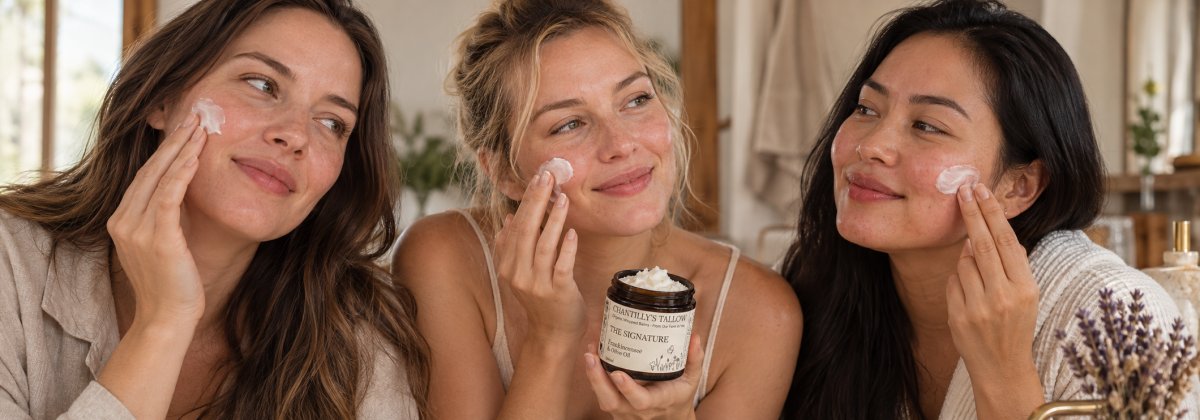
Tallow balm for dry skin works because it replaces the lipids a mature barrier is no longer producing enough of. It is bio-compatible with human skin cell structure, so it supports skin barrier repair rather than just coating the surface.
After 50, the skin's own lipid production drops and transepidermal water loss climbs. A tallow-based balm addresses that directly. It is rich in the same types of fatty acids the skin uses to build its barrier, which is why many people with sensitive skin, eczema or dermatitis find it comfortable when lighter creams sting.
What most guides miss is that tallow is not a "new" ingredient at all. It is an old one that fell out of fashion when synthetic formulas became cheaper to produce. For skin comfort, firming and long-term hydration, the traditional approach still holds up.
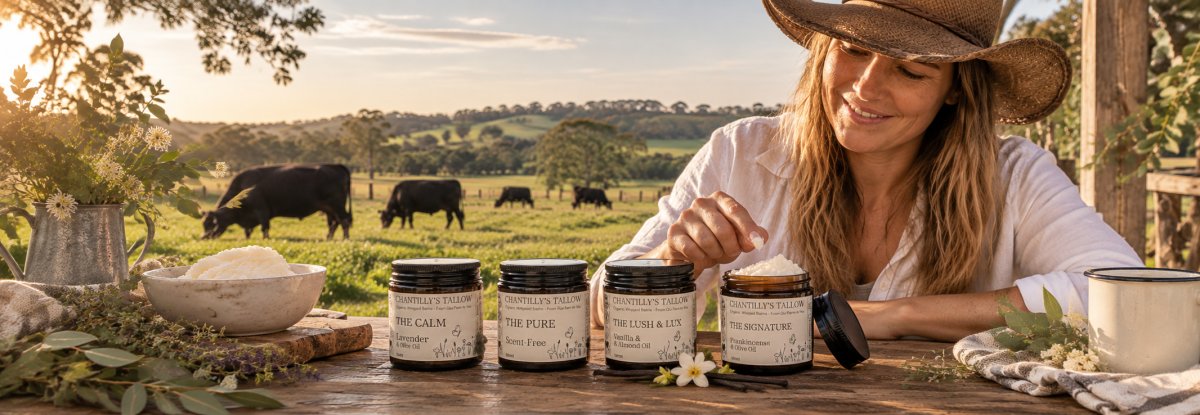
At Chantilly's Tallow, we handcraft small batches from 100% grass-fed, organically-raised beef tallow on our own Gippsland farm, so the formula stays close to nature's skin-food and free from unnecessary additives. Our range also includes an Almond Oil & Vanilla Balm, which softens and comforts with a light, warm scent for everyday use, and a Frankincense Balm, blended richer for extra support on sagging skin and fine lines.
Application Techniques for Sagging Skin and Fine Lines
How you apply matters as much as what you apply. Mature skin responds to gentle, upward, deliberate movement, not aggressive rubbing.
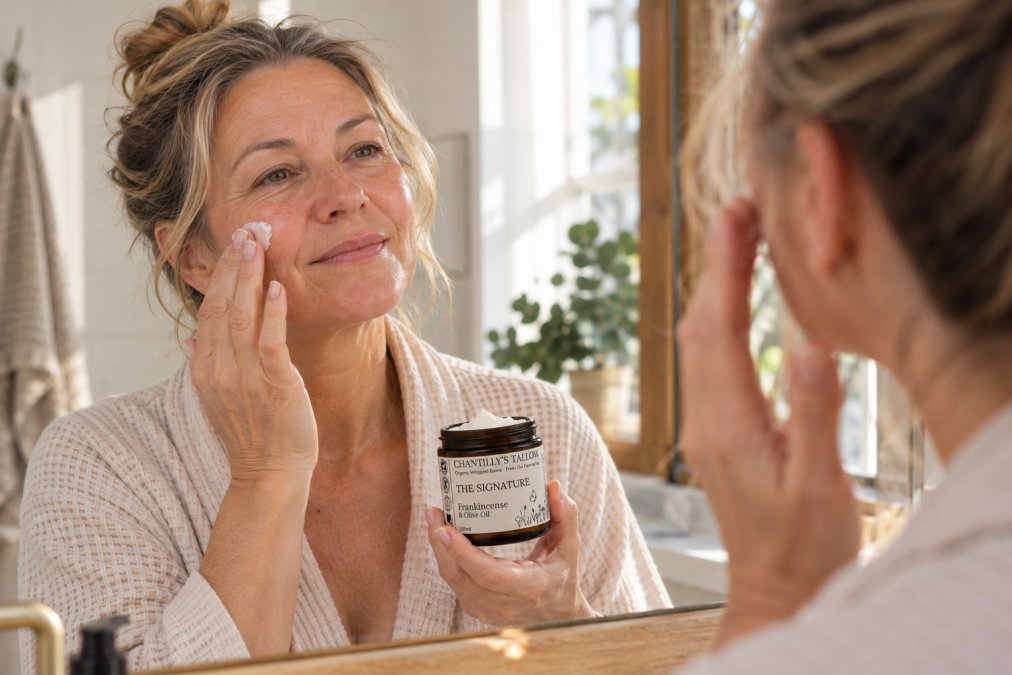
A simple technique that works:
- Warm a small amount of balm between your fingertips
- Press and pat along the jawline, moving upward toward the ears
- Sweep lightly up the cheekbones and forehead, always against gravity
- Finish with the neck, pressing upward from collarbone to jaw
Use less than you think you need. Tallow balm is concentrated, so a pea-sized amount covers the face and neck. Pressing rather than dragging reduces friction on skin that is thinner and more fragile than it used to be.
How to Store Tallow Balm for Maximum Shelf Life
Store tallow balm in a cool, dark place, away from direct sunlight and heat, and keep the lid sealed between uses. Water exposure is the main enemy: never introduce wet fingers into the jar.
Specific storage conditions that matter:
- Temperature: keep below 28°C, ideally in a cupboard rather than a steamy bathroom
- Light: store in the dark; UV accelerates rancidity in oils
- Moisture: always use dry, clean hands or a small spatula
- Shelf life: typically around 12 months sealed, and about 6 months once opened, depending on storage conditions
If the balm develops a sharp, bitter or "off" smell, or changes texture noticeably, it has turned. A slight change in firmness between seasons is normal for a natural fat and not a sign of spoilage.
Building a Natural Anti-Ageing Skincare Routine
A natural anti-ageing skincare routine for your fifties does not need ten steps. It needs four done consistently.
Morning:
- Rinse with lukewarm water (skip harsh cleansers if skin feels tight)
- Apply a hydrating serum to damp skin
- Seal with tallow balm (Almond & Vanilla)
- Finish with SPF protection
Evening:
- Cleanse gently to remove sunscreen and grime
- Apply balm to slightly damp skin
- Add a richer layer on dry patches or use it as an overnight mask. (Frankincense)
That is it. The temptation with mature skin is to add more products, but a stripped barrier reacts worse to a crowded routine. Fewer, richer, more consistent steps win.
For environmental factor customisation: in dry, heated indoor air, layer a little more balm. In humid weather, use less and let the skin's own hydration do more of the work.
Choosing the Right Natural Moisturizer for Your Skin
Choosing the right natural moisturizer for your skin comes down to four questions: how dry you are, how reactive you are, what climate you live in, and how much time you will realistically spend on a routine.
Match the Formula to Your Skin Type
- Very dry or flaky skin: a tallow-based balm with a rich lipid profile
- Sensitive or reactive skin: synthetic fragrance-free and paraben-free formulas, minimal ingredients
- Combination skin: balm on dry zones, lighter layers on the T-zone
- Oily but ageing skin: a small amount of balm at night only
- Normal skin wanting a lighter, everyday moisturizer: an almond oil and vanilla balm for gentle, lightweight nourishment
- Mature skin looking for extra firmness support: a frankincense balm, valued for its traditional use in supporting skin elasticity and tone
Look for nontoxic, organic ingredients and cold-pressed oils where possible. Avoid synthetic fragrance, drying alcohols and long lists of fillers. If a formula stings, it is not "working harder", it is irritating a barrier that is already compromised.
Customise for Your Climate
This is the step most guides skip, and it changes everything. The same balm that feels perfect in one environment can feel heavy or insufficient in another, because humidity determines how much water your skin gains or loses through the day.
Humid climates (coastal, tropical, wet summers):
The air already holds plenty of water, so a humectant-heavy layer can pull moisture from the atmosphere into the skin. Use a thinner layer of balm, or apply it only at night. A full pea-sized amount during the day in high humidity can feel occlusive and lead to congestion. If you sweat, rinse with lukewarm water before reapplying rather than layering balm over salt and sebum.
Arid climates (inland, desert, dry winters):
Low humidity reverses the equation: humectants pull water from the deeper skin layers to the surface, where it evaporates faster than it arrived. In these conditions, a lipid-rich balm is not optional, it is the whole point. Apply to slightly damp skin after cleansing, and reapply a thin layer midday if skin feels tight. Running a humidifier in heated rooms makes a measurable difference to how much balm your skin needs.
Heated indoor air (winter, air-conditioned offices):
Heating and air conditioning strip moisture from the air even when it is humid outside. Treat indoor air as an arid climate. A slightly heavier layer of balm in the morning, and a second thin layer before bed, is often enough to hold the barrier through the day.
Seasonal transitions:
Most people need two settings, not one. A lighter application in summer and a richer one in winter is normal. If your skin suddenly feels tight in the same routine that worked a month ago, check the season before you blame the product.
Chantilly's Tallow makes this simple: one bio-compatible balm that covers hydration, barrier support and anti-ageing care in a single step, safe for all ages and gentle enough for the most sensitive skin. Adjust the amount to your climate, not the product.
Frequently Asked Questions
What is the best natural moisturizer for a woman in her 50s?
Look for a natural moisturizer that supports barrier repair, lipid replenishment and elasticity rather than just adding surface hydration. Tallow balm, cold-pressed plant oils and botanical extracts that mimic skin's own lipids work well because they help reduce transe epidermal water loss. A non-comedogenic, paraben-free formula with no synthetic fragrance suits sensitive skin and delivers lasting comfort through the day.
How does tallow balm benefit mature skin?
Tallow balm is rich in fat-soluble vitamins and fatty acids that closely match human skin cell structure, so it absorbs without stripping the barrier. For mature skin dealing with fine lines, deep-set wrinkles and dullness, it provides deep nourishment. Many users find it gentle enough for reactive skin and effective for both face and body.
Is tallow balm suitable for sensitive skin in older adults?
Yes, tallow balm is generally well tolerated by sensitive skin because it contains no synthetic fragrance, parabens or harsh preservatives. Its bio-compatible structure means it works with the skin barrier rather than against it, which helps calm redness and irritation. If you have a diagnosed skin condition, patch test first and check with your dermatologist before replacing prescribed treatments.
What ingredients should I look for in a natural moisturizer for my 50s?
Prioritise ingredients that support skin barrier repair and lipid replenishment: tallow, jojoba, macadamia and olive oil, plus hyaluronic acid and antioxidants like vitamin E. (Almond Oil contains vit E) Cold-pressed oils and botanical extracts retain more nutrients than heavily processed alternatives. Avoid synthetic fragrance, parabens and anything that leaves skin feeling tight or coated.